
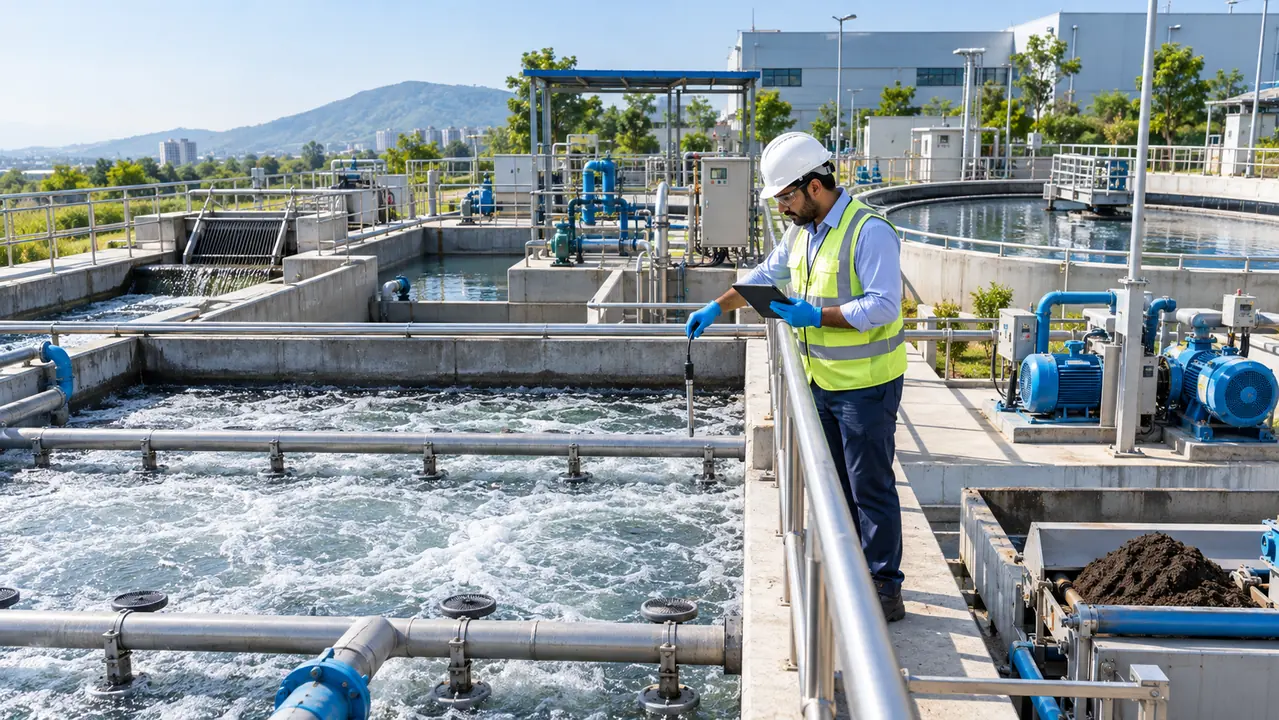
A properly operating Sewage Treatment Plant should not continuously produce a strong foul smell. A mild sewage odour may occasionally be noticed near specific treatment stages, but a persistent rotten-egg, septic or sludge-like smell usually indicates that something inside the collection, treatment or sludge-management system needs attention.
In hotels, hospitals, factories, commercial buildings, residential campuses and institutions, recurring STP odour can quickly become a facility-management, operator-safety and process-performance issue.
Why Does an STP Smell?
Persistent STP smell is commonly caused by septic sewage, insufficient aeration, wastewater stagnation, anaerobic conditions, accumulated sludge, poor sludge handling, clogged screens, long retention in collection tanks or ineffective odour-control systems.
A rotten-egg smell is commonly associated with hydrogen sulphide formation under oxygen-deficient conditions. Identify the exact source first, then correct the process or operating condition causing it.
A properly operating Sewage Treatment Plant should not continuously produce a strong foul smell.
A mild sewage odour may occasionally be noticed near specific treatment stages, but a persistent rotten-egg, septic or sludge-like smell usually indicates that something inside the collection, treatment or sludge-management system needs attention.
In hotels, hospitals, factories, commercial buildings, residential campuses and institutions, STP smell can quickly become more than an operating inconvenience.
It can lead to:
- Complaints from occupants or employees
- Poor working conditions for STP operators
- Neighbourhood complaints
- Negative perception of facility management
- Corrosion around affected areas
- Biological-treatment instability
- Recurring maintenance interventions
The wrong approach is to simply spray deodorizer around the plant.
The right question is:
Where is the smell being generated, and what process condition is causing it?
That is where effective STP troubleshooting begins.
Persistent STP smell is commonly caused by septic sewage, insufficient aeration, wastewater stagnation, anaerobic conditions, accumulated sludge, poor sludge handling, clogged screens, long retention in collection tanks or ineffective odour-control systems.
A rotten-egg smell is commonly associated with hydrogen sulphide formation under oxygen-deficient conditions.
The solution is to identify the exact odour source first, then correct the process or operating condition causing it.
You will learn:
- Where STP smell usually originates
- Why sewage develops a rotten-egg smell
- How low aeration contributes to odour
- Why collection and equalization tanks can become septic
- How sludge management affects STP smell
- What operators should check first
- When recurring odour may require STP modification or revamping
Is STP Smell Normal?
A sewage-treatment plant handles organic matter and biological processes, so some odour near raw sewage handling points can occur.
But persistent strong odour throughout the STP area is not something that should simply be accepted as normal.
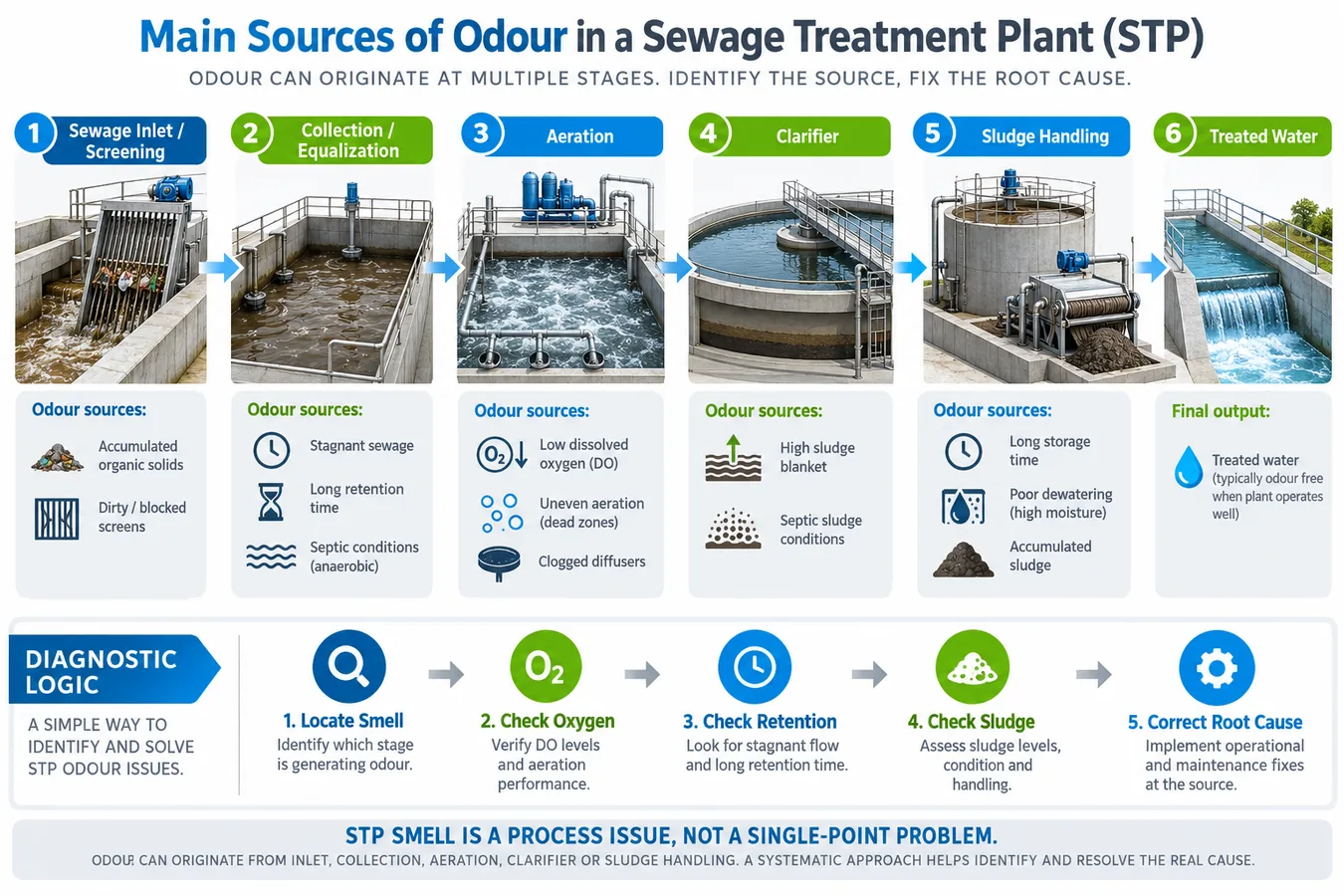
CPHEEO's Manual on Sewerage and Sewage Treatment Systems identifies several locations where hydrogen sulphide odour can arise, including:
- Choked or stagnant sewers
- Pumping-station sumps
- Screen chambers
- Equalization tanks
- Primary clarifiers
- Sludge thickeners
- Sludge digesters
- Sludge dewatering units
The manual emphasizes avoiding unnecessary stagnation of raw sewage and sludge.
That gives us an important troubleshooting rule:
Start by locating the smell before trying to control it.
What Does a Rotten-Egg Smell Usually Indicate?
A rotten-egg type smell commonly points towards hydrogen sulphide, or H₂S.
Hydrogen sulphide can form when sewage or sludge remains under oxygen-deficient or anaerobic conditions.
Typical situations include:
- Sewage standing too long
- Insufficient aeration
- Blocked or stagnant lines
- Septic collection tanks
- Sludge stored too long
- Anaerobic zones inside poorly mixed tanks
Apart from odour, H₂S also deserves attention because it can create occupational-safety and corrosion concerns at elevated concentrations.
Do not identify gas exposure by smell alone.
Appropriate monitoring and safe operating procedures should be used where H₂S accumulation is possible.
1. Sewage Is Staying Too Long Before Treatment
One of the most common odour problems starts before the biological treatment system.
If sewage remains for too long in:
- Collection tank
- Pumping sump
- Equalization tank
- Transfer line
oxygen gets depleted.
The wastewater begins to become septic.
Possible reasons
- Pumping frequency is too low
- Tank is oversized for current flow
- Pumps are not operating correctly
- Flow has dropped significantly
- Dead zones exist inside the tank
- Mixing is poor
- Sewage is retained overnight or during shutdown periods
What to check
Measure or estimate:
Then inspect whether sewage remains stagnant for extended periods.
Practical solution
Depending on the plant:
- Improve pumping frequency
- Prevent unnecessary storage
- Improve tank mixing
- Eliminate dead zones
- Review control logic
- Introduce appropriate aeration where the process requires it
2. Aeration Is Insufficient
In an aerobic STP, microorganisms need oxygen.
If aeration becomes inadequate, biological activity changes and odour can develop.
CPHEEO's STP operation guidance notes that a rotten-egg smell in an aeration system can indicate inadequate air supply, and recommends checking dissolved oxygen at multiple locations in the aeration tank rather than relying only on visual observation.
Why low aeration occurs
Possible causes include:
- Blower capacity is inadequate
- Blower performance has deteriorated
- Diffusers are clogged
- Air distribution is uneven
- Organic load has increased
- MLSS is too high
- Air leaks are present
- Aeration cycles are incorrect
- Blowers are being switched off to save electricity
Important point
Seeing bubbles does not prove that the tank has sufficient dissolved oxygen.
Measure DO.
3. Blowers Are Being Switched Off for Long Periods
This is a surprisingly common operating mistake.
Sometimes STP blowers are switched off:
- During the night
- During low occupancy
- To reduce electricity cost
- Because operators assume sewage load is low
But biological activity continues.
Oxygen can fall quickly.
This can create:
CPHEEO's extended-aeration guidance calls for continuous operation of aeration equipment for that process and recommends maintaining appropriate DO through actual measurement.
The correct blower strategy depends on the STP process and actual load, but energy saving should not create anaerobic conditions.
4. Diffusers Are Choked or Aeration Is Uneven
A blower may appear to be running normally while actual oxygen transfer has deteriorated.
Common problems include:
- Choked fine-bubble diffusers
- Damaged membranes
- Blocked air lines
- Uneven air distribution
- Incorrect valves
- Air leakage
Visual clue
If one part of the aeration tank is strongly aerated while another area appears almost stagnant, the tank may have poor air distribution.
What to check
- DO at several tank locations
- Blower discharge pressure
- Airflow
- Diffuser pattern
- Mixing condition
Do not judge aeration performance using blower status alone.
5. The Collection or Equalization Tank Has Become Septic
The equalization tank is often a major odour source.
Its purpose is to balance incoming sewage flow and load.
However, if sewage remains there too long without adequate movement or aeration, it may become septic.
Signs
- Strong smell near the tank
- Darker wastewater
- Bubbling unrelated to aeration
- Odour suddenly released when pumps start
- Smell worse after weekends or shutdowns
Possible solutions
- Reduce unnecessary retention
- Improve mixing
- Improve transfer scheduling
- Check pumps
- Review aeration requirements
- Prevent solids accumulation
6. Screenings and Grit Are Not Being Removed Frequently
Odour does not always come from the biological process.
Organic solids trapped at:
- Bar screens
- Fine screens
- Grit chambers
- Collection channels
can decompose quickly.
Check:
- Screen-cleaning frequency
- Screenings storage
- Grit accumulation
- Waste disposal practices
- Housekeeping around inlet structures
CPHEEO's O&M guidance recommends regular cleaning and removal of accumulated material and immediate cleaning of sewage and sludge spills to reduce odour and improve working conditions.
7. Sludge Is Being Stored Too Long
Sludge handling is another major source of smell.
Problems may occur in:
- Sludge holding tanks
- Sludge drying beds
- Sludge dewatering systems
- Filter press areas
- Sludge storage zones
If sludge remains unstabilized for too long, anaerobic decomposition can create strong odour.
Check
- Sludge wasting frequency
- Sludge holding time
- Tank mixing/aeration
- Dewatering frequency
- Sludge disposal schedule
- Cleaning after dewatering
CPHEEO specifically identifies sludge thickeners, digesters, drying beds and dewatering facilities among potential odour sources.
8. Excess Sludge Is Not Being Wasted Properly
An activated-sludge system needs controlled sludge wasting.
If sludge age becomes excessive:
- Biomass condition can deteriorate
- Solids can accumulate
- Settling may become poor
- Odour can increase
- Clarifier performance may suffer
Likewise, excessive sludge wasting can destabilize biological treatment.
Review together
- MLSS
- Sludge age
- Return sludge
- Waste sludge
- Settling
- DO
Sludge management should be treated as part of biological control, not merely waste disposal.
9. The STP Has Dead Zones
Tanks can contain areas where wastewater circulation is poor.
These zones can accumulate:
- Sludge
- Organic solids
- Grease
- Septic wastewater
They may occur because of:
- Poor tank geometry
- Incorrect mixer placement
- Inadequate aeration pattern
- Changed operating levels
- Process modifications
Result
Most of the tank may appear healthy while one area continuously generates odour.
A site inspection should therefore examine mixing patterns, not only laboratory results.
10. Oil, Grease or Food Waste Is Entering the STP
This is especially relevant for:
- Hotels
- Hospitals
- Commercial kitchens
- Food facilities
- Campuses
- Canteens
Poor grease trapping can send excessive oil, fat and food material into the sewage system.
This can:
- increase organic loading,
- create scum,
- interfere with oxygen transfer,
- accumulate in tanks,
- worsen odour.
Check
- Grease traps
- Kitchen wastewater
- Food solids
- Scum removal
- Tank surfaces
Source control is usually more effective than trying to remove everything later at the STP.
11. The STP Is Underloaded
STP problems are not always caused by excessive load.
An STP designed for high occupancy may receive very little sewage during:
- low hotel occupancy,
- reduced factory workforce,
- seasonal operation,
- partially occupied buildings.
This can create:
- long retention times,
- insufficient food for biomass,
- septic collection conditions,
- poor biological balance.
The STP operating strategy may need adjustment to match the actual load.
12. The STP Is Overloaded
The opposite can also happen.
If occupancy, staff count or production has increased, the STP may receive:
- higher flow,
- higher BOD,
- higher COD,
- greater solids load.
Then the biological process can become oxygen-limited.
Compare
with
Do not look only at tank size.
13. Clarifier Sludge Has Become Septic
Settled sludge should not remain indefinitely in the clarifier.
If sludge withdrawal is poor:
- sludge blanket rises,
- solids remain too long,
- anaerobic conditions can develop,
- gas bubbles may lift solids,
- odour can appear.
Check
- Sludge blanket
- Return-sludge pumping
- Waste-sludge schedule
- Sludge pump condition
- Clarifier scraper where applicable
14. Sewage or Sludge Is Spilling Around the Plant
Sometimes the process is not the main problem.
Persistent spills around:
- pumps,
- filter presses,
- pipelines,
- sludge dewatering units,
- channels
can generate strong local odour.
CPHEEO's O&M manual recommends immediately flushing sewage and sludge spills and maintaining a defined housekeeping schedule.
Housekeeping will not repair an underperforming biological process, but poor housekeeping can create odour even when the process itself is healthy.
STP Smell Troubleshooting Table
| Where You Smell It | Likely Cause | First Check |
|---|---|---|
| Collection tank | Septic sewage | Retention time, pumping |
| Equalization tank | Stagnation / low oxygen | Mixing, aeration |
| Aeration tank | Low DO | DO, blower, diffusers |
| Clarifier | Septic sludge | Sludge withdrawal |
| Screen chamber | Decomposing screenings | Cleaning frequency |
| Sludge tank | Excess holding time | Wasting/dewatering |
| Filter press area | Old sludge / spills | Cleaning and disposal |
| Throughout STP | Multiple process issues | Full performance audit |
| Weekend/startup | Long stagnation | Operating schedule |
| Only near kitchen inlet | Oil/food load | Grease trap |
Find the Odour Source Before Adding Chemicals or Equipment
Recurring smell can come from collection, equalization, aeration, clarification or sludge handling. A structured STP review can identify whether the real issue is operational, mechanical or process-related.
Explore STP Solutions →What Should You Check First When an STP Smells?
Use a systematic sequence.
Step 1: Locate the Strongest Odour
Walk the plant safely and identify whether smell is strongest at:
- inlet,
- collection tank,
- equalization,
- aeration,
- clarifier,
- sludge section.
Do not assume all STP smell comes from one source.
Step 2: Identify the Type of Smell
A rotten-egg smell points towards sulphide/septic conditions.
Other odours may suggest:
- grease,
- sludge,
- chemicals,
- industrial wastewater contamination.
Odour character is a clue, not a substitute for testing.
Step 3: Measure Dissolved Oxygen
If smell occurs around aerobic biological treatment, check DO at multiple locations and depths.
CPHEEO specifically recommends taking measurements throughout the aeration tank rather than relying on one point.
Step 4: Check Sewage Retention Time
Review:
- Collection volume
- Incoming flow
- Pump timing
- Equalization volume
- Shutdown conditions
Long storage encourages septicity.
Step 5: Inspect Aeration Equipment
Check:
- blowers,
- diffusers,
- air lines,
- valves,
- pressure,
- distribution.
Step 6: Check Sludge
Review:
- sludge blanket,
- return sludge,
- wasting,
- holding,
- dewatering,
- disposal.
Step 7: Check Screens and Housekeeping
Remove:
- screenings,
- accumulated solids,
- grease,
- spilled sewage,
- old sludge.
Step 8: Compare Current Load With STP Design
Review:
- actual occupancy,
- actual sewage flow,
- BOD/COD load,
- operational schedule.
Determine whether the STP is significantly underloaded or overloaded.
Do Not Hide STP Smell With Perfume
Masking agents may make the surrounding area temporarily more comfortable.
They do not solve:
- septic wastewater,
- low DO,
- sludge accumulation,
- inadequate aeration,
- poor mixing,
- hydraulic problems.
Likewise, chemical odour-control methods should be applied only after understanding the source and process requirement.
CPHEEO's O&M manual describes chemical addition as one option for odour management, alongside operational measures, cleaning and treatment of septic conditions.
When Is an Odour-Control System Required?
Some plants can remain odorous even when the treatment process is well controlled because raw sewage and sludge-handling operations naturally release gases.
For such cases, engineering odour-control solutions may include:
- covering selected treatment units,
- extraction ventilation,
- chemical scrubbers,
- activated-carbon systems,
- biological odour-control systems,
- improved ventilation.
The technology should match:
- odour source,
- airflow,
- gas characteristics,
- plant layout,
- proximity to occupants,
- operating requirements.
Do not enclose tanks or spaces without considering ventilation, access and confined-space safety.
When Does STP Smell Indicate a Bigger Performance Problem?
Repeated odour requires a deeper STP assessment when accompanied by:
- high BOD/COD outlet,
- low DO,
- sludge bulking,
- poor settling,
- excessive foam,
- cloudy treated water,
- recurring biological failure,
- frequent blower issues,
- high energy consumption,
- increasing occupancy/load,
- old equipment,
- operator dependency.
At that point the issue may no longer be:
“How do we remove the smell?”
It may be:
“Why is the STP process repeatedly becoming unstable?”
STP Optimization vs Revamping
Operational Correction May Be Enough When:
- Aeration timing is wrong
- Screen cleaning is poor
- Sludge wasting is inconsistent
- Pump timing creates stagnation
- Instruments need calibration
- Operators need better process control
Equipment Upgrade May Be Needed When:
- Blower performance is inadequate
- Diffusers are damaged
- Pumps are unreliable
- Mixing is insufficient
- Sludge handling is inadequate
Process Revamping May Be Needed When:
- Actual load exceeds the original design
- Tank configuration is unsuitable
- Retention time is insufficient
- Biology repeatedly fails
- Major dead zones exist
- Reuse requirements have changed
- Existing technology no longer meets operating needs
Hydropure Insight: Smell Is a Symptom
When an STP smells repeatedly, the best starting point is not:
“Which deodorizer should we use?”
Start with:
Where is the smell strongest?
Is wastewater or sludge becoming septic?
Is oxygen adequate?
Is sludge being managed properly?
Is actual load compatible with the STP design?
Is the problem operational, mechanical or process-related?
Once that is clear, the corrective action becomes much more reliable.
STP Smell Problem at Your Facility?
Hydropure Consultants can assess recurring odour and STP performance issues from a process, equipment and operating perspective.
The assessment may include:
- Sewage flow and load
- Collection and equalization
- Retention time
- Aeration
- DO profile
- Blowers and diffusers
- Biological-treatment performance
- Sludge management
- Clarifier performance
- Screens and inlet structures
- Equipment condition
- Instrumentation
- Operating practices
- Potential process improvements
For facilities in Chhatrapati Sambhajinagar / Aurangabad, Jalna, Nashik, Ahilyanagar / Ahmednagar and other relevant Maharashtra locations, the objective is to identify the actual odour source before recommending equipment or treatment modifications.
Request an STP Performance Review
Persistent STP Smell at Your Facility?
Hydropure Consultants can assess recurring odour and STP performance issues from a process, equipment and operating perspective, including collection, retention, aeration, dissolved oxygen, sludge management, clarifier performance, equipment condition and operating practices.
Request an STP Performance ReviewFAQs
Why does my STP smell like rotten eggs?
A rotten-egg smell commonly indicates hydrogen sulphide formation, often associated with septic sewage or sludge under oxygen-deficient conditions. Check collection tanks, equalization, pumping, aeration and sludge areas first. CPHEEO identifies stagnant sewage and several STP treatment/sludge units as typical potential H₂S sources.
Can low aeration cause STP smell?
Yes. In an aerobic process, insufficient oxygen can create poor treatment conditions and contribute to foul odour. Measure DO across the aeration tank and inspect blowers, diffusers and airflow rather than judging aeration visually.
Should STP blowers run continuously?
It depends on the treatment process and operating strategy. For extended aeration, CPHEEO guidance calls for continuous aeration and monitoring of DO. Blower operation should ultimately be controlled around the process's actual oxygen requirement, not arbitrary switching.
Can sludge cause STP odour?
Yes. Excess sludge holding time, septic sludge, poor sludge wasting, drying-bed problems and poor dewatering-area housekeeping can all generate odour.
Why does STP smell increase after weekends?
Lower sewage flow, interrupted pumping, reduced aeration or long retention during shutdown periods can allow sewage to become septic. Review weekend operating schedules, tank levels, aeration and pumping.
Can chemicals permanently solve STP smell?
Not usually if the root cause is inadequate aeration, stagnation, sludge accumulation or process imbalance. Chemicals can play a role in specific odour-control strategies, but the underlying operating condition should be corrected first.
Does persistent STP smell mean the plant needs revamping?
Not automatically. Many odour problems are operational or equipment-related. Revamping becomes more relevant when odour occurs together with repeated treatment failure, inadequate capacity, poor tank configuration or major equipment/process limitations.