
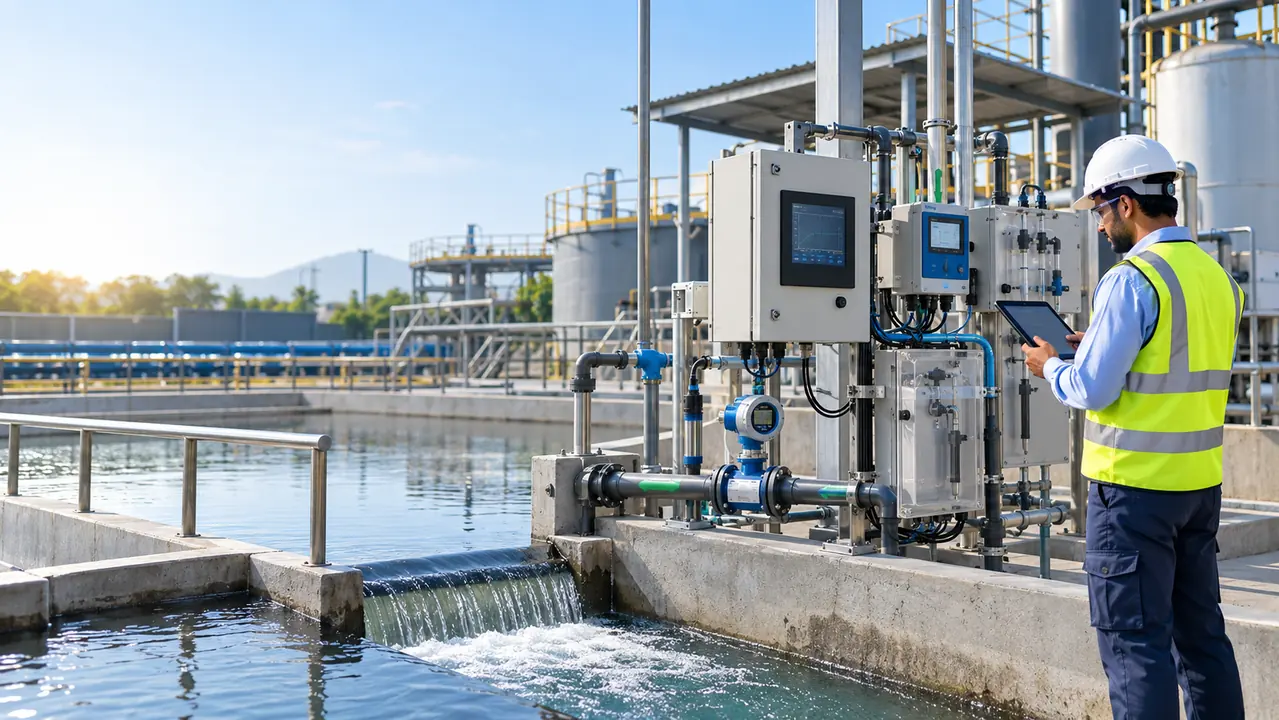
OCEMS full form is Online Continuous Emission and Effluent Monitoring System. In wastewater-treatment applications, OCEMS commonly refers to continuous online monitoring of effluent parameters at an ETP, STP or industrial discharge point.
This guide explains the OCEMS meaning, how the monitoring chain works, which parameters may be measured, and how CPCB/MPCB connectivity, calibration and plant-level response fit together.
OCEMS Full Form and Meaning
OCEMS stands for Online Continuous Emission and Effluent Monitoring System. In wastewater applications, the term is commonly used for online continuous effluent monitoring at an ETP, STP or industrial discharge point.
OCEMS uses online sensors, analysers, flow meters, data acquisition and connectivity systems to monitor selected parameters. Depending on the industry and consent conditions, these may include pH, COD, BOD, TSS, flow, temperature and sector-specific pollutants.
If your industry operates an ETP, STP, process stack or other pollution-control system, you may already have heard terms such as:
- OCEMS
- Online effluent monitoring
- CEMS
- Real-time monitoring
- MPCB connectivity
- CPCB server connectivity
- Online COD monitoring
But for many Plant Heads, Environment Heads and EHS teams, one practical question remains:
What exactly does OCEMS mean, who needs it, what gets monitored, and what does a Maharashtra industry need to do to operate it correctly?
OCEMS is more than an online analyser mounted near an ETP outlet.
It is a complete monitoring system involving:
For Maharashtra industries, this matters because MPCB maintains a dedicated online CEMS/OCEMS framework for real-time environmental-data submission, including API-based connectivity and prescribed data-transmission procedures.
OCEMS stands for Online Continuous Emission and Effluent Monitoring System.
For wastewater applications, it uses online sensors and analysers to continuously measure selected parameters at an ETP, STP or effluent-discharge point.
Depending on the applicable industry and consent conditions, parameters may include:
- pH
- COD
- BOD
- TSS
- flow
- temperature
- ammoniacal nitrogen
- chromium
- fluoride
- phenol
- cyanide
- other sector-specific parameters
The system can then transmit monitoring data to the relevant pollution-control-board server where required. CPCB's guidelines specify different online effluent parameters by industrial category rather than one identical set for every facility.
You will learn:
- What OCEMS means in practical terms
- The difference between OCEMS and CEMS
- Which industries may require OCEMS
- Which wastewater parameters can be monitored
- How MPCB online connectivity works
- How often data is transmitted in Maharashtra
- Why calibration and maintenance matter
- What industries should check before purchasing a system
- What OCEMS can and cannot tell you about ETP performance
OCEMS Full Form: What Does OCEMS Stand For?
OCEMS broadly refers to:
Online Continuous Emission and Effluent Monitoring System
In practical use, people may also use OCEMS when referring specifically to an online continuous effluent monitoring system installed at an industrial wastewater outlet.
The system continuously or frequently generates environmental-monitoring data rather than depending only on periodic manual sampling.
For wastewater, an OCEMS arrangement can include:
- online analysers,
- pH probes,
- flow meters,
- TSS sensors,
- COD analysers,
- sample-conditioning systems,
- PLC/data logger,
- connectivity hardware,
- software,
- data server integration.
OCEMS vs CEMS: What Is the Difference?
These terms are often mixed together.
CEMS
Continuous Emission Monitoring System
Generally used for monitoring pollutants in:
- stacks,
- boilers,
- furnaces,
- process emissions.
Typical emission parameters can include:
- PM
- SO₂
- NOx
- CO
- flow
depending on the source and requirement.
OCEMS / Online Effluent Monitoring
Used for continuous monitoring of:
- ETP outlet
- STP outlet
- industrial effluent
- selected wastewater parameters.
Typical parameters can include:
- pH
- COD
- BOD
- TSS
- flow
plus sector-specific parameters.
MPCB's online monitoring system handles environmental data for effluent, emissions and ambient-air-quality monitoring as separate monitoring streams.
Why Was OCEMS Introduced?
Traditional environmental monitoring relies heavily on physical sampling and laboratory analysis.
That remains important, but it provides a snapshot.
Industrial wastewater can change within hours because of:
- production batches,
- chemical cleaning,
- process changes,
- shutdown/startup,
- high-load discharges,
- equipment failure.
Continuous monitoring provides better visibility of these variations.
CPCB states that its OCEMS initiative began in 2014 to promote self-regulation among highly polluting industries. CPCB's more recent factsheet says OCEMS has been implemented across the 17 highly polluting industry categories, Ganga-basin GPIs, common hazardous and biomedical-waste incinerators, CETPs and STPs.
Is OCEMS Mandatory for Every Industry in Maharashtra?
No.
This is one of the most important points for industry management.
Do not assume that every Red, Orange or industrial facility automatically requires exactly the same OCEMS installation.
Applicability can depend on:
- industrial sector,
- consent conditions,
- CPCB directions,
- MPCB directions,
- wastewater discharge,
- location,
- specific pollutants,
- common-facility requirements.
Historically, CPCB directions covered the 17 categories of highly polluting industries and common treatment facilities for installation of online continuous monitoring systems.
Your plant's current MPCB Consent to Operate and applicable regulatory directions should therefore be the first documents reviewed.
Which Industries Are Commonly Associated With OCEMS Requirements?
CPCB's online-monitoring guidelines contain industry-specific effluent parameters for sectors including:
- Aluminium
- Distillery
- Dyes and dye intermediates
- Chlor-alkali
- Fertilizer
- Iron and steel
- Oil refinery
- Petrochemical
- Pesticides
- Pharmaceuticals
- Thermal power
- Pulp and paper
- Sugar
- Tanneries
- Zinc
- Copper
- Textile GPIs
- Dairy GPIs
- Slaughterhouses
The parameter requirements differ by sector.
Maharashtra's industrial categorization also includes many major pollution-intensive sectors under its Red-category framework, but industry categorization alone should not be used as a substitute for checking the actual OCEMS condition in the relevant consent or direction.
Which Parameters Are Monitored in OCEMS?
There is no universal list for every plant.
Depending on the industrial category, CPCB's published monitoring table includes parameters such as:
- pH
- BOD
- COD
- TSS
- flow
- ammoniacal nitrogen
- fluoride
- chromium
- arsenic
- phenol
- cyanide
- AOx
- temperature.
For example, CPCB's published table specifies pH, BOD, COD, TSS and flow for several sectors including distilleries, oil refineries, pharmaceuticals, sugar and tanneries, while other sectors have different prescribed parameters.
Practical rule
Do not purchase an analyser simply because another factory uses it.
First identify:
your consented parameters + applicable online-monitoring requirement + process requirement.
Does OCEMS Only Monitor the ETP Outlet?
For regulatory purposes, the required monitoring point is generally linked to the applicable discharge or monitoring location defined by regulation, consent or direction.
But plant-performance monitoring may go further.
For example:
Regulatory monitoring
Final ETP Outlet
- pH
- COD
- TSS
- flow
Internal process monitoring
Equalization
- pH
- flow
Aeration
- dissolved oxygen
Clarifier
- sludge / solids trend
Final outlet
- regulatory parameters
This is an important distinction.
OCEMS tells you what is happening at the monitored point. Internal process monitoring helps explain why it is happening.
How Does an OCEMS System Work?
A practical wastewater OCEMS architecture looks like this:
Sensor / Sample Collection
Online Analyser
Data Acquisition / Logger
Local Monitoring
Communication System
MPCB/CPCB Server where applicable
Behind this simple flow are several critical components.
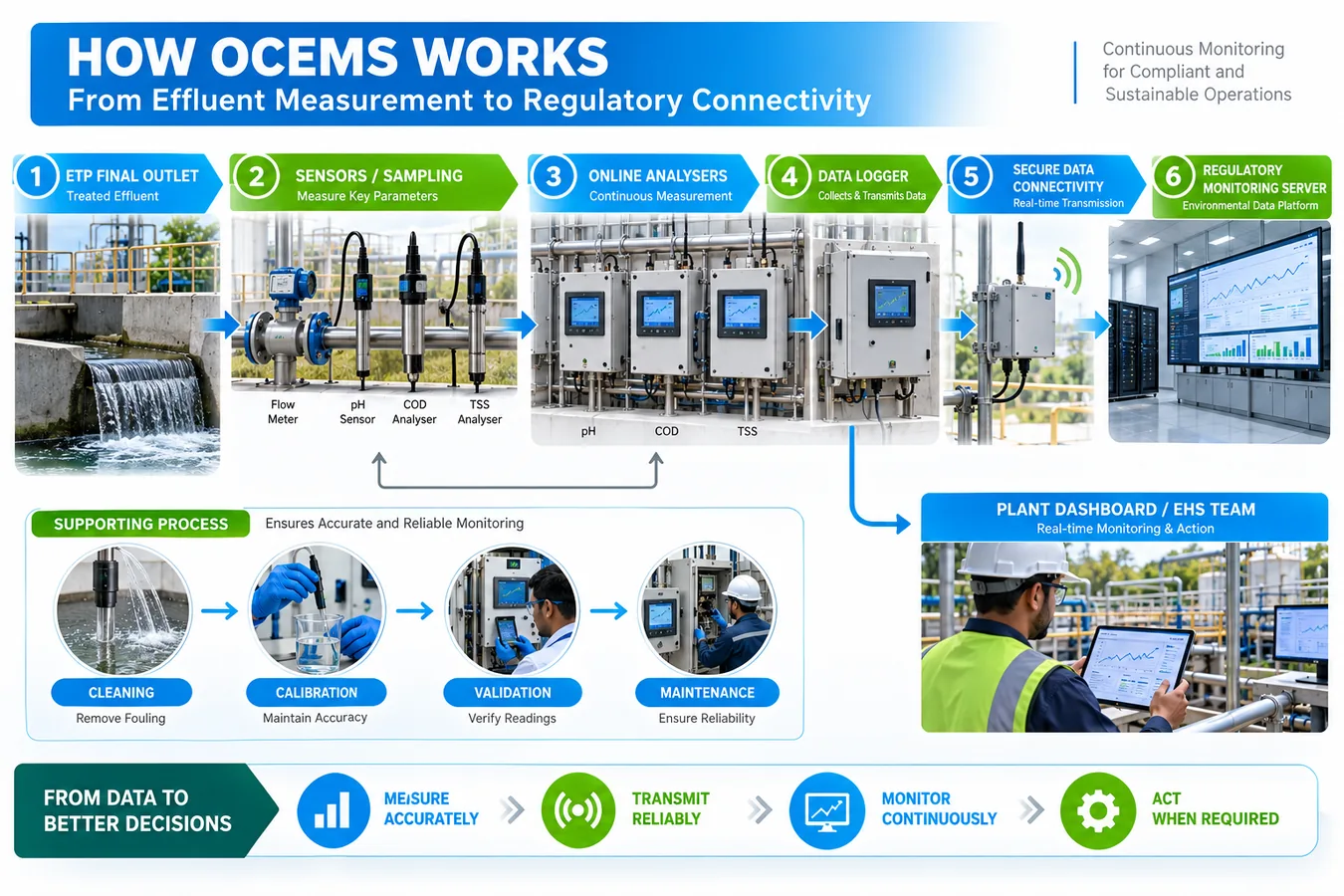
1. Sensor or Analyser
This measures the required parameter.
Examples:
- pH probe
- COD analyser
- TSS analyser
- flow meter.
2. Sample-Conditioning System
Depending on the analyser, wastewater may need:
- pumping,
- filtration,
- settling,
- cleaning,
- controlled sample delivery.
Poor sample conditioning can create poor data even when the analyser itself is good.
3. Data Logger / Acquisition System
The monitoring value is captured electronically.
This system may:
- store data,
- timestamp readings,
- calculate averages,
- generate alerts,
- prepare data for transmission.
4. Communication Layer
The system then sends data to the required remote platform.
For Maharashtra, MPCB's current SOP says real-time uploads use an HTTP REST interface, not FTP.
5. Regulatory Server
Where applicable, the industry registers with the MPCB online CEMS system and connects its monitoring station.
MPCB's procedure states that its team verifies the industry's parameter details and registers the industry on the server before online connectivity is completed.
How Does MPCB OCEMS Connectivity Work?
For a Maharashtra industry, MPCB currently describes the following broad process:
Step 1
Set up the relevant online monitoring system.
Step 2
Register the industry through MPCB's Online CEMS system if not already registered.
Step 3
Submit the relevant monitoring parameters.
Step 4
MPCB verifies and registers the site.
Step 5
The industry receives the connectivity information needed for online data submission.
Step 6
Monitoring data is transmitted through MPCB's published API structure.
MPCB's current guidance specifically provides:
- Standard Operating Procedure
- API for online data submission
- FAQ for online submission
- industry OCEMS data access.
How Frequently Is OCEMS Data Sent to MPCB?
This is particularly important for Maharashtra industries.
MPCB's current SOP states:
Transmission is to occur at one-minute frequency.
It specifies that:
- readings are polled at 10-second intervals,
- a one-minute average is calculated,
- the one-minute data is transmitted,
- data not transmitted within 15 minutes is treated as delayed data.
This means OCEMS connectivity is not simply occasional upload of a daily reading.
It is designed as a near-real-time monitoring system.
Is the MPCB System FTP-Based?
No.
MPCB's current SOP explicitly states that online monitoring uploads are HTTP REST based and that there is no FTP-based transmission under the stated system.
This matters when selecting:
- data loggers,
- communication gateways,
- monitoring software,
- integration vendors.
Does MPCB Need a Separate Monitoring System for Effluent and Emissions?
MPCB's current SOP says the online monitoring systems should be separate for:
- Effluent
- Emissions
- Ambient Air Quality
where those systems are applicable.
For an industry planning both stack and wastewater monitoring, the architecture should therefore be reviewed carefully rather than assuming one generic monitoring stream covers everything.
What Should Industries Check in Their Consent?
Before talking to an OCEMS supplier, open your current MPCB consent.
Look for:
- ETP capacity
- STP capacity
- permitted discharge
- treated-effluent requirement
- monitoring conditions
- online-monitoring directions
- parameters mentioned
- data-connectivity requirements
- reuse/recycle requirements
- special conditions.
MPCB requires industries or processes discharging trade effluent to obtain the applicable environmental consent, first as Consent to Establish and subsequently Consent to Operate once the required pollution-control systems are established.
Therefore your consent should remain the plant-specific starting point.
OCEMS Does Not Replace the ETP
This sounds obvious, but it matters.
An OCEMS system:
measures performance.
It does not treat wastewater.
If COD remains high, a better analyser will reveal the problem more clearly.
It will not remove COD.
If pH changes, the monitoring system can alert you.
It does not automatically correct the process unless it has been deliberately integrated into a suitable control strategy.
The sequence is:
OCEMS Does Not Automatically Guarantee Compliance
Another misconception is:
“We installed OCEMS, so compliance is taken care of.”
No.
The system can help demonstrate and monitor performance.
But compliance still depends on:
- wastewater treatment,
- plant operation,
- outlet quality,
- maintenance,
- calibration,
- applicable consent conditions.
Online monitoring is therefore part of the compliance system, not a replacement for treatment performance.
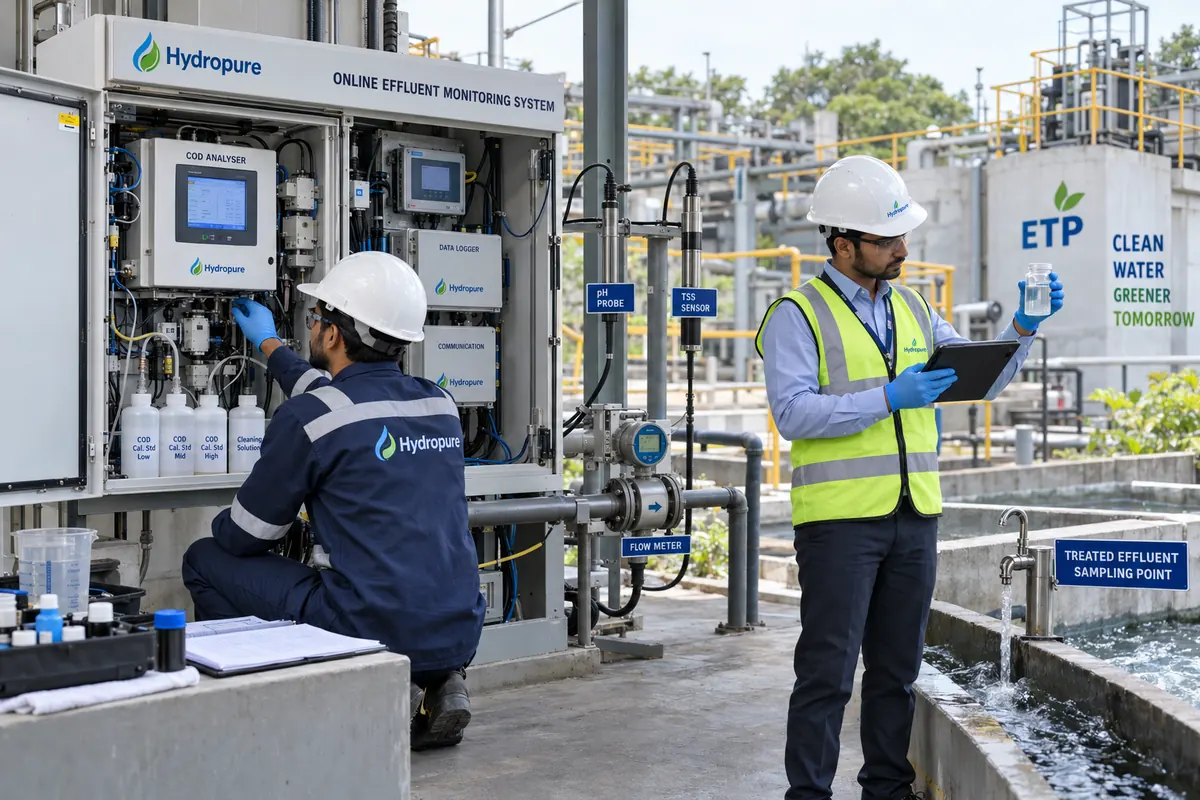
Why Calibration Is Critical
Continuous wastewater instruments operate in difficult conditions.
Sensors may be exposed to:
- solids,
- oil,
- grease,
- scaling,
- biological growth,
- chemicals,
- corrosive wastewater.
Over time, the measurement can drift.
That means:
displayed number ≠ necessarily correct number
unless the system is properly:
- cleaned,
- maintained,
- calibrated,
- validated.
CPCB's OCEMS protocols specifically address technology selection, installation, operation, calibration and IT/data-submission requirements.
Online Reading vs Laboratory Result
Plant teams sometimes find:
Online COD = 180 mg/L
while:
Laboratory COD = 240 mg/L
The natural reaction is to assume the analyser is defective.
That may be true.
But possible reasons can also include:
- different sampling time,
- different sample location,
- sensor drift,
- calibration,
- suspended-solids variation,
- sample conditioning,
- different analytical principle.
The correct response is not simply to change the displayed value.
Investigate the measurement chain.
Can an Industry Adjust OCEMS Readings Manually?
A regulatory monitoring system should be designed to preserve data integrity.
CPCB's protocols exist partly to standardize monitoring, calibration and data submission, and MPCB requires structured online submission through its registered connectivity framework.
Any suspected incorrect reading should therefore be handled through proper:
- calibration,
- validation,
- maintenance,
- documented corrective action,
not arbitrary data manipulation.
Common OCEMS Problems
Industries frequently encounter practical issues such as:
Sensor Fouling
Solids or biological growth cover the measuring surface.
Sampling-Line Blockage
Calibration Drift
Readings gradually move away from actual values.
Data Connectivity Failure
The instrument measures correctly but data does not reach the server.
Power Failure
Monitoring stops.
Reagent or Consumable Issues
Some analyser technologies require regular consumables.
Poor Instrument Location
The analyser receives an unrepresentative sample.
No Preventive Maintenance
The system is serviced only after it fails.
An OCEMS System Has Four Different Health Checks
Plant teams should separately verify:
1. Measurement Health
Is the sensor reading correctly?
2. Sampling Health
Is representative wastewater reaching the analyser?
3. Communication Health
Is data reaching the server?
4. Process Health
Is the ETP actually performing correctly?
These are not the same thing.
A Practical Example
Imagine an industrial plant where outlet COD suddenly rises.
The OCEMS displays:
COD ↑
What should the operator do?
Not immediately recalibrate.
First determine whether:
Scenario A
Laboratory COD also increased.
Then investigate the ETP.
Scenario B
Lab COD remains normal.
Then investigate:
- analyser,
- calibration,
- sample system.
Scenario C
OCEMS values disappear.
Then investigate:
- power,
- analyser,
- logger,
- communication,
- server connectivity.
This distinction prevents wasted troubleshooting effort.
Define the Monitoring Requirement Before Selecting Hardware
Start with your consent conditions, treatment process, required parameters, monitoring point, data users and the action expected from abnormal readings. Only then should the analyser and connectivity architecture be finalized.
Explore Continuous Online Monitoring →What Should You Ask an OCEMS Supplier?
Before purchasing a system, ask these questions.
Technical
- What measurement technology is used?
- What is the operating range?
- What wastewater interferences affect it?
- Is sample conditioning required?
- How is automatic cleaning handled?
Calibration
- How is calibration carried out?
- How frequently?
- What standards/reagents are required?
- Can calibration history be retrieved?
Maintenance
- What routine maintenance is required?
- What consumables are used?
- What is recommended preventive maintenance?
- What spares should be kept onsite?
Connectivity
- Is the proposed architecture compatible with the current MPCB connectivity process?
- Who handles registration and commissioning support?
- How is communication failure detected?
- Is local buffering available during connectivity loss?
Service
- What is the breakdown-response process?
- Is AMC available?
- Who provides local technical support?
Do Not Select OCEMS Only on Lowest Purchase Price
The cheapest analyser is not necessarily the lowest-cost system over five years.
Evaluate:
Purchase cost
Consumables
Calibration
Maintenance
AMC
Spares
Downtime
Service availability
A monitoring system that remains offline for long periods has little operational value regardless of its purchase price.
OCEMS Vendor vs Water-Treatment Consultant: Why Both Perspectives Matter
Instrumentation companies understand analysers.
IT/integration companies understand data transmission.
But an ETP monitoring requirement also needs water-treatment understanding.
For example:
Where should the sample be taken?
What COD range should the analyser handle?
Why is the reading fluctuating?
Which additional internal parameter would help diagnose the issue?
That is where Hydropure's role can differ.
Regulatory Monitoring vs Plant Intelligence
OCEMS answers:
What is leaving the plant?
But a Plant Head may also want to know:
Why is it changing?
A more useful monitoring architecture may combine:
Regulatory Outlet Monitoring
Internal Process Monitoring
such as:
- inlet flow,
- equalization pH,
- aeration DO,
- tank levels,
- clarifier condition.
Then monitoring evolves from:
to
From OCEMS to Industrial Water Intelligence
The progression can look like this:
Level 1
Level 2
Online sensors
Level 3
Continuous monitoring
Level 4
Alerts and trends
Level 5
Process diagnosis
Level 6
Operational optimization
This aligns with Hydropure's broader industrial-water-performance approach:
Treat → Monitor → Optimize → Comply
The technology should support water-treatment decisions rather than become the centre of the proposition.
Maharashtra Industry OCEMS Checklist
Before procurement or upgrade, verify:
Regulatory
- ☐ Current MPCB Consent to Operate reviewed
- ☐ Applicable CPCB/MPCB direction reviewed
- ☐ Required parameters identified
- ☐ Monitoring location identified
- ☐ Online connectivity requirement confirmed
Instrumentation
- ☐ Measuring range confirmed
- ☐ Technology evaluated
- ☐ Interferences reviewed
- ☐ Sample conditioning understood
- ☐ Installation point reviewed
Calibration
- ☐ Calibration method defined
- ☐ Frequency defined
- ☐ Standards/consumables identified
- ☐ Calibration records planned
Data
- ☐ Data logger selected
- ☐ Local data retention provided
- ☐ One-minute MPCB transmission requirement checked
- ☐ Communication failure alerts provided
Integration
- ☐ MPCB registration process confirmed
- ☐ API compatibility confirmed
- ☐ HTTP REST connectivity considered
- ☐ Delayed-data handling understood
Operations
- ☐ Operator training
- ☐ Preventive maintenance
- ☐ AMC
- ☐ Local technical support
- ☐ Critical spares
Plant Performance
- ☐ ETP process reviewed
- ☐ Monitoring data linked to operator actions
- ☐ Laboratory cross-check procedure defined
When Should You Review an Existing OCEMS Installation?
Consider an audit when:
- online and lab results repeatedly differ,
- sensors frequently fail,
- communication drops regularly,
- MPCB data transmission is unreliable,
- maintenance cost is rising,
- process conditions have changed,
- ETP has been revamped,
- production has increased,
- consent conditions changed,
- operators do not trust the data.
The audit should determine whether the problem lies in:
sampling
calibration
data acquisition
connectivity
ETP performance
before replacement is recommended.
Hydropure Insight: Don't Buy an Instrument Before Defining the Monitoring Problem
Before selecting hardware, answer five questions:
1. Why are we monitoring?
2. Which parameters actually matter?
3. Where should they be measured?
4. Who needs the data?
5. What action should follow an abnormal reading?
Only then should the instrument and data architecture be finalized.
Planning OCEMS for Your Maharashtra Plant?
Hydropure Consultants can support industries in evaluating online wastewater monitoring from the combined perspective of:
Treatment + Monitoring + Performance + Compliance
The scope can include:
- Consent and requirement review
- ETP/STP process assessment
- Parameter selection
- Monitoring-point selection
- Existing OCEMS assessment
- Instrumentation requirement
- Data-connectivity planning
- MPCB connectivity coordination requirements
- Calibration planning
- Dashboard and alerts
- Process-monitoring strategy
- Plant-performance integration
For facilities in Chhatrapati Sambhajinagar / Aurangabad, Jalna, Nashik, Ahilyanagar / Ahmednagar and relevant locations across Maharashtra, the aim should be to build a system that produces reliable, useful and actionable wastewater data.
Discuss Your OCEMS Requirement
Planning OCEMS for Your Maharashtra Plant?
Hydropure Consultants can support industries in evaluating online wastewater monitoring from the combined perspective of Treatment + Monitoring + Performance + Compliance, including consent review, parameter selection, monitoring-point selection, existing OCEMS assessment, calibration planning, connectivity coordination requirements and process-monitoring strategy.
Discuss Your OCEMS RequirementFrequently Asked Questions
What is the full form of OCEMS?
OCEMS stands for Online Continuous Emission and Effluent Monitoring System. In wastewater-treatment discussions, the term is commonly used for online continuous monitoring of effluent parameters.
Is OCEMS compulsory for every Red-category industry?
Not automatically. Applicability depends on CPCB/MPCB directions, industrial category, facility-specific consent conditions and the relevant environmental requirement. Review the current Consent to Operate before deciding.
Which parameters are monitored through OCEMS?
They vary by sector. CPCB's published guidelines include combinations of pH, BOD, COD, TSS, flow, chromium, arsenic, ammoniacal nitrogen, phenol, cyanide and other parameters depending on industry category.
How frequently does an industry send OCEMS data to MPCB?
MPCB's current published SOP specifies transmission at one-minute frequency, using one-minute averages based on 10-second polling.
How is OCEMS data connected to MPCB?
MPCB provides an online registration and API-based connectivity system. Its current SOP specifies HTTP REST-based data transmission.
Does installing OCEMS guarantee environmental compliance?
No. OCEMS measures environmental performance. Compliance still depends on treatment performance, applicable limits, operating practices, calibration and maintenance.
Does OCEMS replace laboratory testing?
No. Laboratory testing remains important for validation, confirmation and parameters that may not be continuously measured online.
Why do OCEMS and laboratory results sometimes differ?
Possible causes include sample timing, sampling location, calibration drift, analyser technology, suspended solids, sample conditioning or maintenance issues.
Can OCEMS help improve ETP performance?
Yes, particularly when regulatory outlet monitoring is combined with selected process parameters such as inlet flow, pH and aeration DO. This allows operators to detect process changes earlier.