
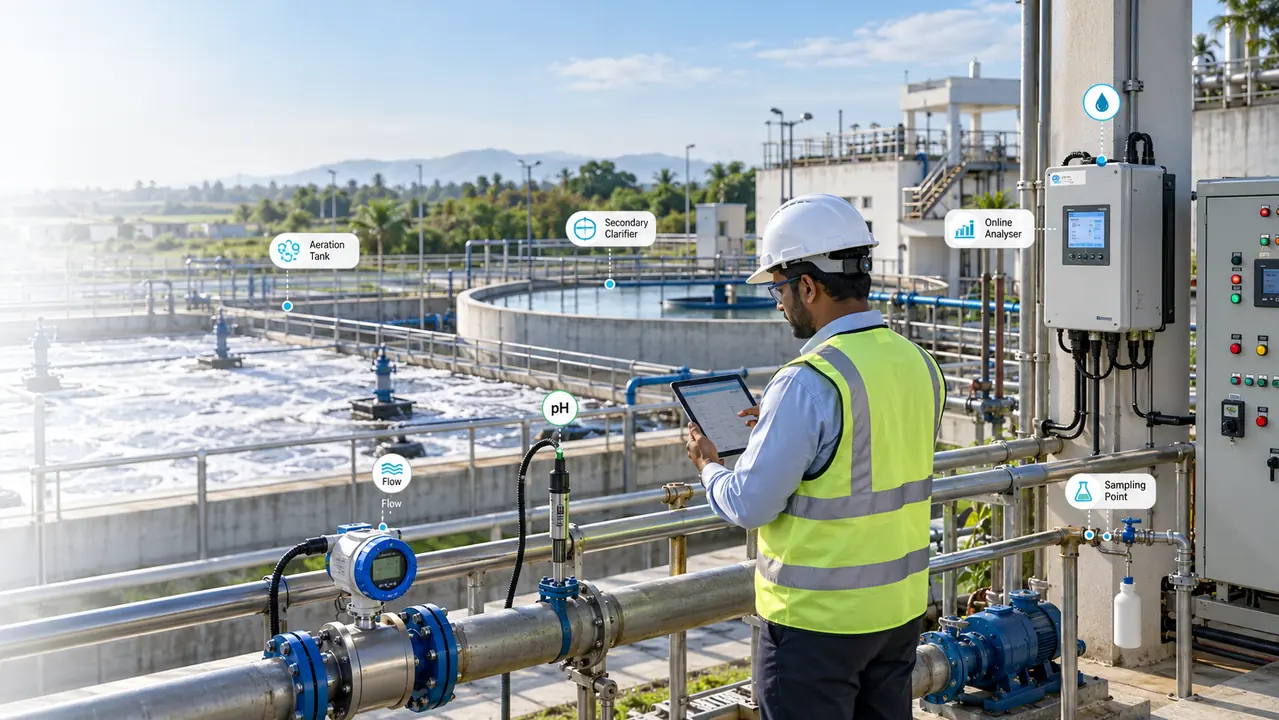
An ETP or STP can look perfectly normal from the outside and still experience significant variation in treatment performance during the day. pH may suddenly change, COD load may increase after a production batch, flow may spike, dissolved oxygen may fall, or a pump or analyser may stop working.
This is why wastewater monitoring is moving from periodic checking towards continuous visibility. For industries and facilities, online wastewater monitoring can support two different but connected objectives: regulatory monitoring and better treatment-plant operation.
What Is Online Wastewater Monitoring?
Online wastewater monitoring uses sensors, analysers, flow meters and connected data systems to continuously or frequently measure selected wastewater parameters at an ETP, STP or discharge point.
Depending on the plant and applicable requirement, parameters may include pH, flow, COD, BOD, TSS, temperature, ammoniacal nitrogen, conductivity and other industry-specific pollutants.
An ETP or STP can look perfectly normal from the outside and still experience significant variation in treatment performance during the day.
pH may suddenly change.
COD load may increase after a production batch.
Flow may spike.
Dissolved oxygen may fall.
A pump or analyser may stop working.
The final outlet may move towards an undesirable condition long before anyone notices it during a routine laboratory test.
This is why wastewater monitoring is moving from periodic checking towards continuous visibility.
For industries and facilities, online wastewater monitoring can support two very different objectives:
Regulatory monitoring
better treatment-plant operation.
They are related, but they are not the same thing.
A system installed only to send numbers to a regulator may satisfy one requirement.
A well-designed monitoring system can also help a plant team understand:
- what is entering the ETP,
- how the treatment process is behaving,
- when performance starts deteriorating,
- where intervention is required,
- and whether the final outlet remains stable.
That distinction is important.
Online monitoring should not simply generate data. It should help the plant act before a treatment problem becomes a compliance or operating problem.
Online wastewater monitoring uses sensors, analysers, flow meters and connected data systems to continuously or frequently measure selected wastewater parameters at an ETP, STP or discharge point.
Depending on the plant and applicable requirement, parameters may include:
- pH
- flow
- COD
- BOD
- TSS
- temperature
- ammoniacal nitrogen
- conductivity
- other industry-specific pollutants
CPCB defines online effluent monitoring as continuous monitoring of effluent from industrial discharge points, with analysers installed at ETP/STP outlets and data generated at intervals ranging from seconds to minutes.
You will learn:
- What online wastewater monitoring actually does
- How OCEMS fits into regulatory monitoring
- Which parameters may be monitored
- Which industries have historically been directed to install online systems
- How Maharashtra industries connect data to MPCB
- Why calibration and maintenance matter
- What online monitoring cannot replace
- How monitoring can improve ETP/STP performance
- What to check before investing in a system
What Is OCEMS?
OCEMS stands for Online Continuous Effluent Monitoring System.
It is part of the broader online environmental monitoring framework used to continuously measure selected effluent parameters and transmit data where required.
CPCB's published framework for online emission and effluent monitoring was introduced to strengthen pollution monitoring, regulatory visibility and self-monitoring by industries.
An OCEMS installation may include:
- Online analysers
- Sensors
- Flow meters
- Sample-conditioning system
- Data logger
- Communication system
- Remote data connectivity
- Calibration arrangement
- Data-transmission software
- Server connectivity
However, installing instruments alone does not automatically make a reliable monitoring system.
The complete chain matters:
Why Was Online Effluent Monitoring Introduced?
Traditional environmental monitoring often depends on periodic manual sampling.
That gives a snapshot.
But wastewater treatment changes continuously.
An ETP may perform well when a sample is taken at 11 AM and experience a significant process disturbance at 4 PM.
Online monitoring provides greater visibility into these fluctuations.
CPCB states that online monitoring was introduced to strengthen monitoring and self-regulation, with relevant industrial units required to transmit compliance data online.
The broader objective is not simply automation.
It is improved visibility into environmental performance.
Which Industries May Require Online Monitoring?
Do not assume that every factory automatically has the same OCEMS obligation.
Requirements depend on:
- industrial category,
- applicable CPCB/SPCB directions,
- consent conditions,
- location,
- type of discharge,
- sector-specific requirements.
CPCB's published guidance identifies the historical online-monitoring direction for the 17 categories of highly polluting industries, Grossly Polluting Industries in the Ganga basin, and common treatment/facility units.
CPCB's revised guidelines also describe online monitoring requirements associated with highly polluting sectors and common facilities such as CETPs and STPs.
Examples of industries covered within CPCB's highly polluting category framework include sectors such as:
- Pharmaceuticals
- Distilleries
- Sugar
- Pulp & paper
- Tanneries
- Fertilizers
- Petrochemicals
- Refineries
- Pesticides
- Iron & steel
- Chlor-alkali
- other specified sectors
The exact requirement for an individual facility should always be checked against its current Consent to Operate, MPCB/CPCB directions and applicable sector requirements.
Which Parameters Can Be Monitored Online?
CPCB's published FAQ lists effluent parameters including:
- pH
- BOD
- COD
- TSS
- Flow
- Chromium
- Ammoniacal Nitrogen
- Fluoride
- Phenol
- Cyanide
- Temperature
- AOx
- Arsenic
depending on the applicable industry and regulatory direction.
This does not mean every industry needs to monitor every parameter.
The relevant parameters depend on:
- wastewater characteristics,
- sector,
- discharge standards,
- consent conditions,
- regulatory directions.
The Most Important Monitoring Parameters for ETP/STP Operations
From a plant-performance perspective, some variables are particularly useful.
1. Flow
Flow is fundamental.
Without flow data, concentration alone gives an incomplete picture.
Consider:
COD = 2,000 mg/L
That number means something very different at:
20 m³/day
versus
200 m³/day
Together, concentration and flow help estimate pollutant load.
For example:
Flow monitoring can also help detect:
- abnormal discharge
- peak production load
- leaks
- unexpected bypass
- excessive hydraulic loading
- change in wastewater generation
2. pH
pH can change quickly in industrial wastewater.
Sources include:
- acid cleaning
- alkali washing
- CIP
- chemical discharge
- batch processes
A significant pH disturbance can affect:
- chemical treatment
- biological treatment
- coagulation
- precipitation
- downstream equipment
Online pH monitoring can provide early warning before a shock reaches sensitive treatment stages.
3. COD
COD is a useful indicator of overall oxidizable pollutant load.
Continuous or frequent COD monitoring can help identify:
- high-organic-load batches
- production-related changes
- sudden untreated load
- declining ETP performance
- unusual influent conditions
However, COD monitoring systems require proper installation, maintenance and validation to produce meaningful data.
4. TSS
High suspended solids at the outlet can indicate:
- poor clarification
- sludge carryover
- filter problems
- hydraulic overload
- poor settling
Monitoring trends can therefore provide useful information about solids-separation performance.
5. Dissolved Oxygen
DO may not always be part of the regulatory OCEMS outlet requirement, but it can be extremely useful for process monitoring inside aerobic ETPs and STPs.
Low DO may indicate:
- inadequate aeration
- high organic loading
- blower problems
- diffuser fouling
- poor air distribution
This is an important distinction:
Regulatory monitoring asks:
What is leaving the plant?
Process monitoring asks:
Why is the plant behaving this way?
Hydropure should ideally think about both.
Regulatory Monitoring vs Process Monitoring
These are often confused.
| Regulatory Monitoring | Process Monitoring |
|---|---|
| Focuses on compliance/discharge | Focuses on treatment performance |
| Usually at final outlet | Can be at multiple treatment stages |
| Parameters defined by applicable requirement | Parameters selected for process control |
| Data may go to regulatory server | Data may go to internal dashboard |
| Shows what is being discharged | Helps explain why performance changes |
The best industrial monitoring strategy can connect the two.
Why Final-Outlet Monitoring Alone Is Not Enough for Plant Improvement
Imagine that your final COD begins to rise.
The online system tells you:
COD is increasing.
That is useful.
But it does not automatically tell you why.
The cause could be:
- higher incoming load,
- pH shock,
- poor chemical treatment,
- low aeration,
- biological upset,
- sludge carryover,
- hydraulic overload.
To diagnose this, selected internal process measurements may also be useful.
For example:
Inlet Flow + Inlet pH
Equalization
DO in Biological Tank
Clarifier Condition
Final Outlet Monitoring
This gives operators a much more useful picture.
Online Monitoring Should Be an Early-Warning System
A good monitoring system should help identify abnormal conditions before they become serious.
For example:
Situation
Normal outlet pH:
7.0–7.5
Suddenly:
pH begins falling
Instead of waiting for a lab report, the system can create an alert.
The operator can investigate:
- chemical dosing,
- incoming wastewater,
- production discharge,
- probe condition.
Similarly:
Flow spike
→ check production discharge
DO drop
→ check aeration
COD rise
→ check upstream load
TSS rise
→ check clarifier
The data becomes operational intelligence.
How Does MPCB Online Data Connectivity Work?
For industries in Maharashtra, MPCB publishes a Standard Operating Procedure for real-time online monitoring and connectivity.
Its current published procedure states that industries using online monitoring should set up their systems and connect required data to the MPCB server.
For data upload, MPCB describes use of its API-based connectivity framework.
MPCB's published SOP also specifies a data-transmission frequency of one minute, using one-minute average data based on 10-second polling, and identifies delayed-data handling when transmission is not completed within 15 minutes.
This is a useful reminder that OCEMS is not simply:
Sensor → Local display
For regulatory connectivity it can involve:
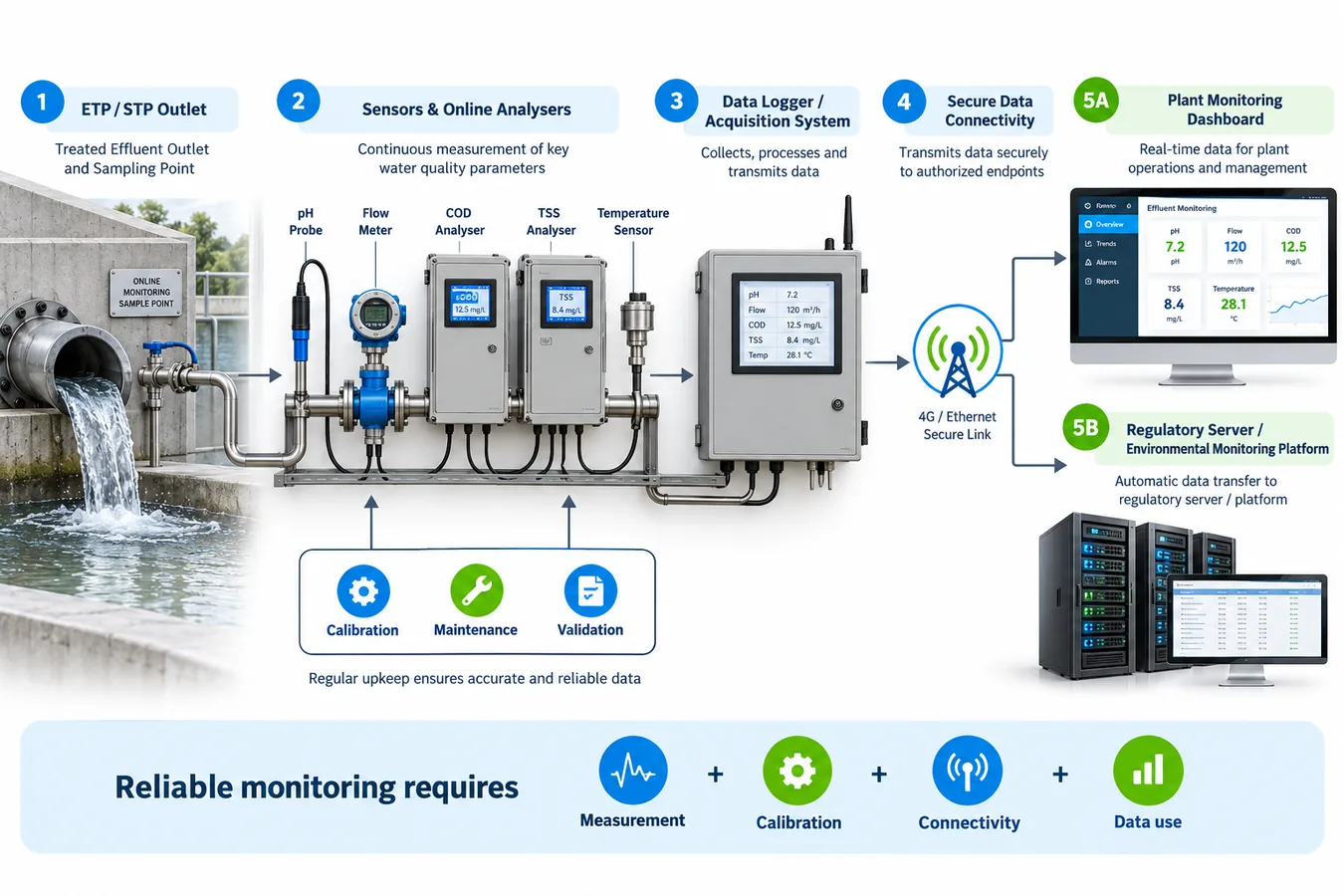
Data Connectivity Is Only One Part of Compliance
A system can successfully transmit data and still produce unreliable measurements.
That is why CPCB's OCEMS protocols cover areas such as:
- equipment selection,
- installation,
- operation,
- calibration,
- data submission,
- IT protocols.
For plant management, the important lesson is:
Connectivity does not prove accuracy.
Accuracy depends on the complete measurement system.
Calibration Is Critical
Online analysers operate continuously in difficult environments.
Wastewater may contain:
- suspended solids
- oil
- chemicals
- biological material
- scaling compounds
- corrosive substances
- foul,
- drift,
- clog,
- lose calibration,
- produce false readings.
CPCB's published FAQ states that CPCB does not certify individual analyser makes and emphasizes calibration protocols, calibration frequency and comparison with manually monitored results.
This makes calibration one of the most important parts of any monitoring strategy.
Online Monitoring Does Not Eliminate Laboratory Testing
This is another common misconception.
Online monitoring offers continuous visibility.
Laboratory analysis provides controlled analytical verification.
CPCB's revised monitoring guidance notes the importance of verification and validation of online measurements, while established sampling and analytical procedures remain relevant for regulatory decision-making unless otherwise directed.
A practical approach is:
Online data
Periodic laboratory verification
Calibration
Trend analysis
rather than treating one method as a complete replacement for the other.
What Can Cause Wrong Online Readings?
A monitoring system may show incorrect or unstable values because of:
- Dirty sensors
- Improper sampling
- Air bubbles
- Sensor drift
- Incorrect calibration
- Wrong installation location
- Sample-line blockage
- Poor maintenance
- Communication failure
- Power interruption
- Instrument ageing
Therefore, when a reading changes suddenly, ask two questions:
Has the wastewater changed?
Is the instrument healthy?
Both must be investigated.
Where Should Sensors Be Installed?
Sensor location matters.
Installing a sophisticated analyser at the wrong point produces misleading data.
Factors to consider include:
- representative flow
- adequate mixing
- accessibility
- cleaning
- calibration access
- sample conditions
- turbulence
- solids
- maintenance safety
For regulatory monitoring, the location should also match applicable CPCB/MPCB requirements.
For process monitoring, additional points may be selected based on what the plant wants to control.
Define the Monitoring Objective Before Selecting Instruments
Regulatory monitoring, internal process control and plant-performance monitoring do not always need the same parameters, locations or architecture. Start with the treatment process and the decisions the data must support.
Explore Continuous Online Monitoring →What Should an Industry Check Before Buying an Online Monitoring System?
Use this checklist before selecting a vendor.
1. Confirm Why You Need Monitoring
Is the objective:
- regulatory compliance,
- internal process improvement,
- both?
This changes the system design.
2. Confirm Applicable Parameters
Do not buy every available analyser.
Check:
- Consent conditions
- CPCB requirements
- MPCB directions
- wastewater characteristics
- operational needs
3. Define Monitoring Locations
Possible locations:
- ETP inlet
- equalization
- biological treatment
- final outlet
- reuse line
- discharge point
Each point should serve a specific purpose.
4. Understand Measurement Technology
Ask the vendor:
- What measurement principle is used?
- What is the expected measurement range?
- What interferes with the sensor?
- What maintenance is needed?
- How frequently does it require calibration?
- How will results be validated?
5. Check Sampling Requirements
Some analysers measure directly in the water.
Others need:
- pumps,
- tubing,
- filtration,
- sample conditioning,
- cleaning.
Understand the entire system.
6. Check Calibration
Ask:
- How is calibration performed?
- Can operators do it?
- What reference standards are needed?
- How often?
- Is calibration history recorded?
7. Check Data Logging
The system should retain useful history.
Plant teams should be able to analyse:
- hourly trends
- daily trends
- parameter excursions
- equipment downtime
- calibration events
8. Check Alerts
Useful alerts might include:
- High pH
- Low pH
- High COD
- High flow
- Low DO
- Sensor failure
- Communication failure
An alarm should trigger a defined operating action.
9. Check Connectivity
For applicable Maharashtra installations, confirm compatibility with MPCB's current data-submission/connectivity requirements before procurement or commissioning. MPCB currently publishes dedicated SOP, API and online data-submission guidance for connected systems.
10. Define Maintenance Responsibility
Ask:
Who will keep this system working six months after installation?
Define:
- daily inspection
- cleaning
- calibration
- consumables
- AMC
- breakdown response
- spare parts
- data-support responsibility
The Biggest Mistake: Installing OCEMS and Forgetting It
An online monitoring system is not a fit-and-forget device.
Without regular attention:
- sensors foul,
- calibration drifts,
- sample systems choke,
- data gaps appear,
- operators stop trusting readings.
Eventually the dashboard becomes something people look at only when there is a compliance issue.
A successful monitoring system needs:
What Should Operators Do With the Data?
The most valuable question is:
What decision changes because we have this data?
Examples:
pH Rising
Investigate incoming process stream or chemical dosing.
DO Falling
Check blower, diffuser or organic loading.
Flow Increasing
Check production or unexpected discharge.
COD Rising
Compare with production schedule and inlet load.
TSS Rising
Inspect clarifier and sludge settling.
This converts monitoring from a reporting system into a plant-management tool.
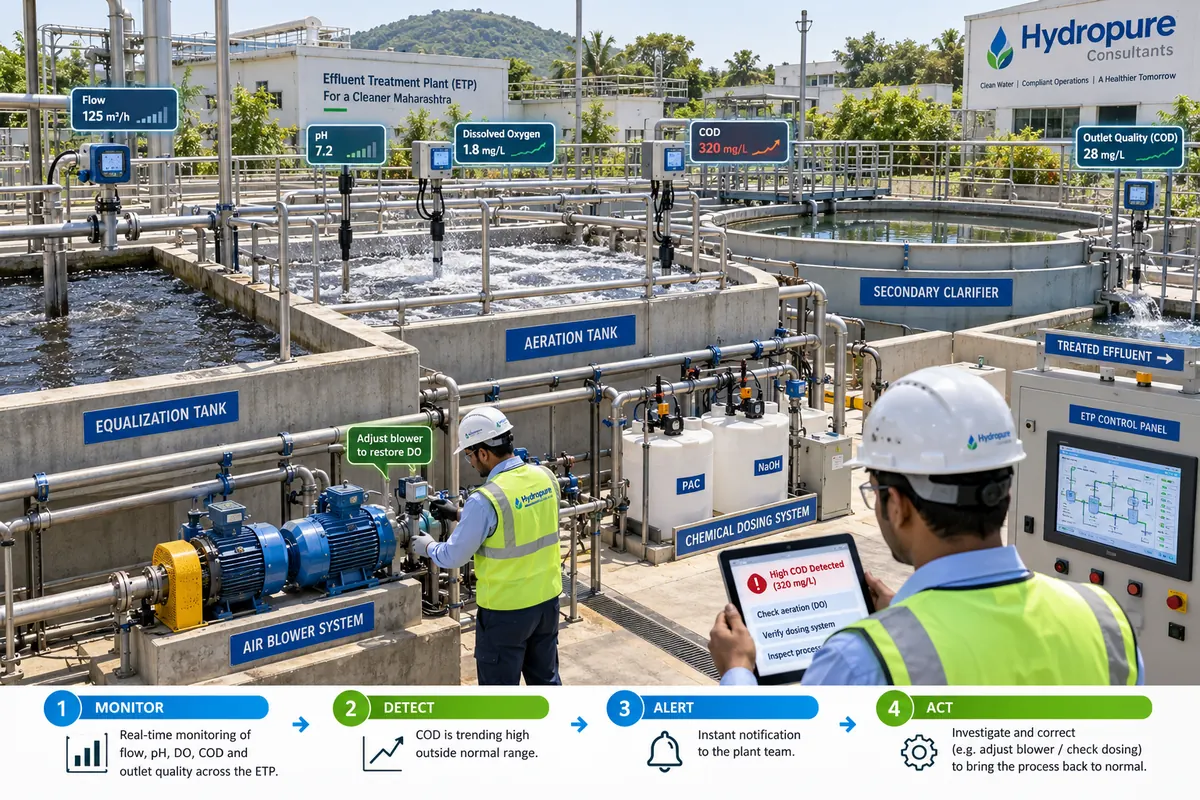
Online Monitoring Can Support Preventive ETP/STP Operation
Without monitoring, many plants operate reactively:
Outlet fails
Operator notices
Correction begins
With meaningful monitoring:
Alert
Operator investigates
Corrective action
Potential failure avoided
That is a significantly more useful operating model.
Monitoring Can Also Help With Water Recovery
Industries planning treated-water reuse need consistent outlet quality.
Online monitoring can help teams understand when water quality is suitable for downstream systems such as:
- filtration,
- RO,
- utility reuse,
- cooling applications,
- selected process reuse.
It can also help identify process instability before poor-quality water reaches sensitive downstream equipment.
Online Monitoring Is Not the Same as Industrial Water Intelligence
It is useful to make another distinction.
Monitoring tells you:
What is happening?
Analysis tells you:
Why is it happening?
Intelligent operating support helps answer:
What should we do next?
An effective digital water-performance system can therefore evolve from:
Data
Trends
Alerts
Diagnosis
Operational action
This is where monitoring begins to create business value beyond regulatory reporting.
Common Online Wastewater Monitoring Mistakes
Avoid these:
- Selecting sensors before reviewing wastewater characteristics
- Monitoring too many unnecessary parameters
- Ignoring calibration
- Poor sensor location
- No laboratory cross-check
- No preventive maintenance
- No alarm-response procedure
- No data history
- No ownership within the plant
- Assuming connectivity equals compliance
- Treating online data as infallible
Online Wastewater Monitoring Checklist
Compliance
- ☐ Current consent reviewed
- ☐ Applicable monitoring requirements identified
- ☐ Parameters confirmed
- ☐ Regulatory connectivity requirement confirmed
Process
- ☐ Treatment process mapped
- ☐ Critical operating parameters selected
- ☐ Monitoring locations identified
Instrumentation
- ☐ Measurement technology evaluated
- ☐ Measurement range confirmed
- ☐ Interference understood
- ☐ Installation condition reviewed
Calibration
- ☐ Calibration procedure defined
- ☐ Frequency defined
- ☐ Reference method defined
- ☐ Records maintained
Data
- ☐ Logging enabled
- ☐ Historical trends available
- ☐ Alerts configured
- ☐ Data backup defined
Connectivity
- ☐ MPCB/CPCB requirement checked
- ☐ Data interface configured
- ☐ Communication health monitored
Operations
- ☐ Operators trained
- ☐ Alarm-response procedure defined
- ☐ Maintenance ownership assigned
- ☐ AMC/spares considered
When Should an Existing Monitoring System Be Upgraded?
Consider reviewing an existing setup when:
- sensors frequently fail,
- data differs significantly from laboratory results,
- data transmission is unreliable,
- parameters required by consent have changed,
- the ETP/STP has been revamped,
- production has changed,
- operators cannot use the data effectively,
- monitoring exists only at the outlet,
- maintenance cost is excessive,
- the system lacks alerts or useful trends.
The goal should not automatically be replacing everything.
Start by determining whether the problem lies in:
sensor → sampling → calibration → connectivity → software → operating practice
Hydropure Insight: Monitor the Process, Not Just the Outlet
Regulatory monitoring naturally focuses on what leaves the plant.
But if an industry wants to improve ETP/STP performance, the most valuable information often begins earlier.
For example:
Inlet flow
Inlet pH
Aeration DO
Clarifier performance
Final outlet
can tell operators far more about treatment behaviour than one outlet number alone.
The objective should be:
Detect the process change before it becomes an outlet problem.
Planning Online Monitoring for an ETP or STP?
Hydropure Consultants can help industries evaluate online wastewater monitoring from both a water-treatment and plant-performance perspective.
The assessment can include:
- ETP/STP process review
- Monitoring requirement
- Parameter selection
- Monitoring-point selection
- Instrumentation requirement
- Online data architecture
- MPCB connectivity considerations
- Dashboard requirements
- Alerts
- Calibration planning
- Integration with plant-performance monitoring
- Existing monitoring-system review
For industries in Chhatrapati Sambhajinagar / Aurangabad, Jalna, Nashik, Ahilyanagar / Ahmednagar and relevant Maharashtra locations, the objective should be to build a monitoring system that provides reliable data and supports meaningful operating decisions.
Discuss Your Online Monitoring Requirement
Planning Online Monitoring for an ETP or STP?
Hydropure Consultants can help evaluate online wastewater monitoring from both a water-treatment and plant-performance perspective, including parameter selection, monitoring-point selection, instrumentation, online data architecture, alerts, calibration planning, MPCB connectivity considerations and existing-system review.
Discuss Your Online Monitoring RequirementFAQs
What is OCEMS in wastewater treatment?
OCEMS stands for Online Continuous Effluent Monitoring System. It uses online analysers and connected data systems to continuously monitor selected effluent parameters and, where required, transmit the data to pollution-control authorities.
Is OCEMS mandatory for every industry?
No. Requirements depend on industry category, applicable regulatory directions and consent conditions. CPCB's published framework has specifically covered highly polluting industry categories, Grossly Polluting Industries and common treatment/facility units.
Which wastewater parameters can be monitored online?
Depending on the applicable requirement, parameters can include pH, COD, BOD, TSS, flow, ammoniacal nitrogen, chromium, fluoride and other sector-specific pollutants.
Does online monitoring replace laboratory testing?
No. Online monitoring provides continuous visibility, while laboratory analysis remains important for verification, validation and parameters that may not be reliably measured online. CPCB guidance specifically recognizes the need for verification and validation of online measurements.
How often is data transmitted to MPCB?
MPCB's current published SOP states that data transmission should occur at one-minute frequency using one-minute average data based on 10-second polling.
Does CPCB certify OCEMS analysers?
CPCB's published FAQ states that CPCB does not certify individual analyser makes. The system still needs to meet applicable requirements, and calibration, validation and comparison with manual monitoring are important.
Can online monitoring improve ETP performance?
Yes, if the data is used operationally. Monitoring flow, pH, COD, DO or other relevant parameters can help identify process changes earlier and allow plant teams to investigate before final outlet quality deteriorates.
What is the difference between OCEMS and ETP process monitoring?
OCEMS generally focuses on required environmental monitoring and regulatory reporting. Process monitoring can include additional internal parameters such as dissolved oxygen, tank levels or intermediate treatment performance to help operators understand and control the ETP itself.