
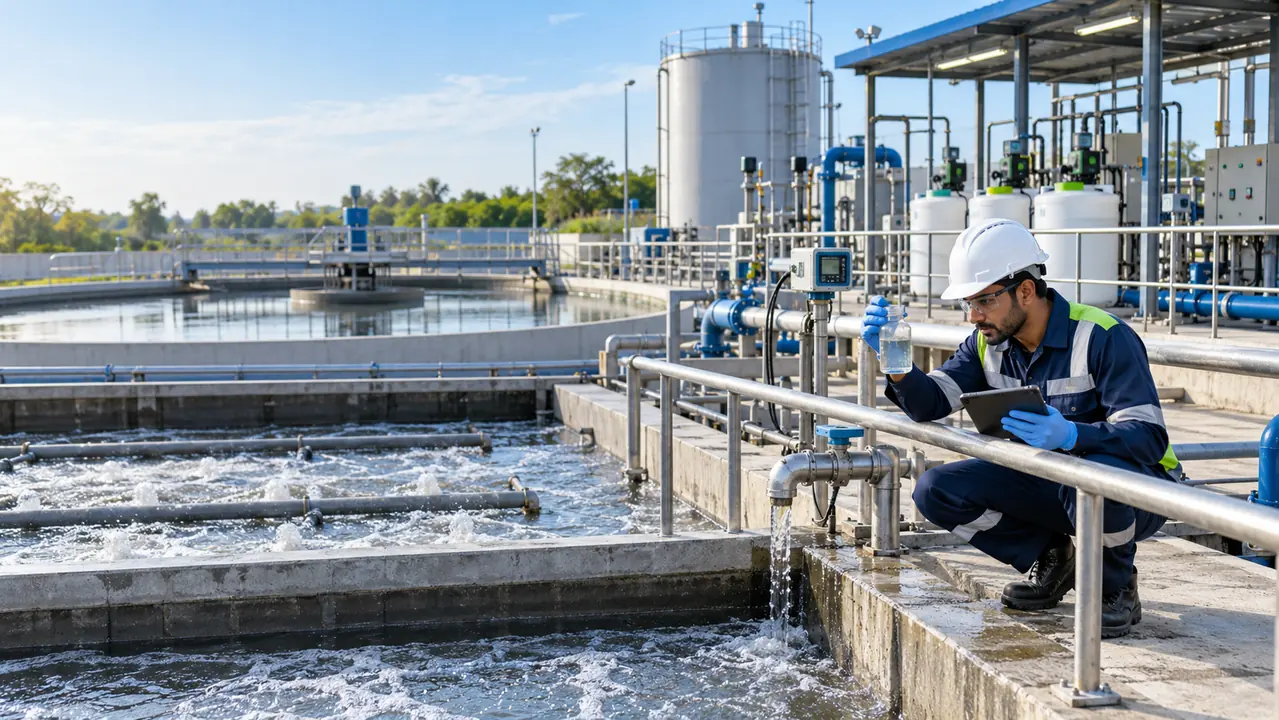
Your ETP is running. The pumps are operating, chemicals are being dosed and the aeration tank looks active. But the laboratory report still shows high COD in the treated water.
The natural reaction is often to increase chemical dosing, increase aeration or blame the biological treatment. That may not solve the problem.
High outlet COD is not a single problem. It is a performance signal showing that some portion of the organic or chemically oxidizable load entering the ETP is not being removed effectively.
Why Is COD High in an ETP Outlet?
High COD in an ETP outlet can result from increased inlet pollution load, poor equalization, incorrect chemical treatment, inadequate aeration, unhealthy biological activity, toxic shock loads, reduced retention time, poor sludge management, hydraulic overloading or wastewater characteristics that the existing ETP was never designed to treat.
The first step should be to compare COD at different treatment stages, rather than immediately increasing chemicals or equipment capacity.
Your ETP is running. The pumps are operating, chemicals are being dosed and the aeration tank looks active.
But the laboratory report still shows high COD in the treated water.
The natural reaction is often to increase chemical dosing, increase aeration or blame the biological treatment.
That may not solve the problem.
High outlet COD is not a single problem. It is a performance signal showing that some portion of the organic or chemically oxidizable load entering the ETP is not being removed effectively.
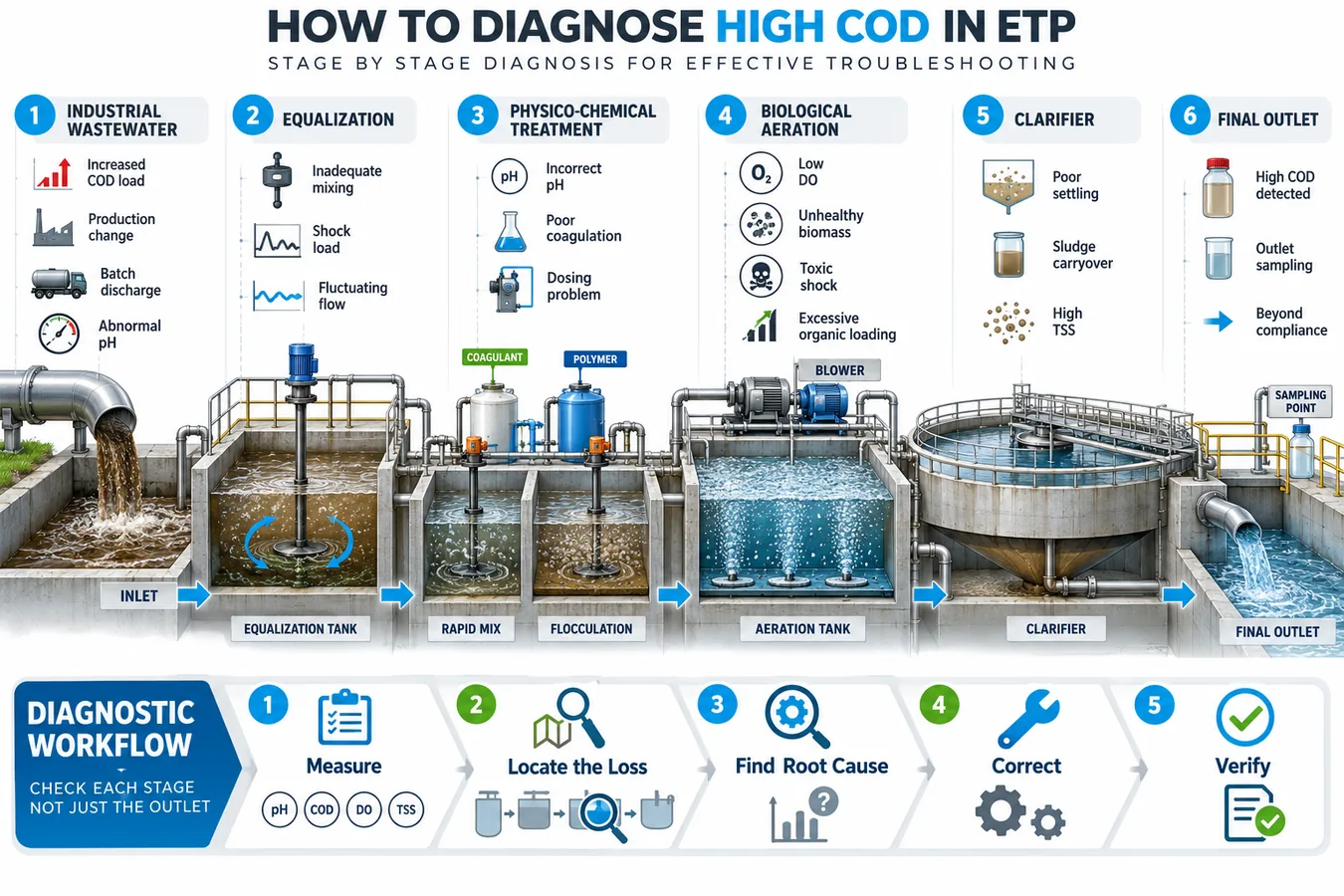
Finding the real cause requires looking at the entire treatment chain:
The important question is not simply:
“Why is COD high?”
It is:
“At which treatment stage is COD removal being lost, and why?”
High COD in an ETP outlet can result from increased inlet pollution load, poor equalization, incorrect chemical treatment, inadequate aeration, unhealthy biological activity, toxic shock loads, reduced retention time, poor sludge management, hydraulic overloading or wastewater characteristics that the existing ETP was never designed to treat.
The first step should be to compare COD at different treatment stages, rather than immediately increasing chemicals or equipment capacity.
You will learn:
- What COD tells you about ETP performance
- Why outlet COD suddenly increases
- The most common causes of poor COD reduction
- What plant teams should check first
- How to identify which ETP stage is underperforming
- When high COD indicates a need for ETP optimization or revamping
What Does COD Mean in an ETP?
Chemical Oxygen Demand, or COD, is an indicator of the amount of oxygen required to chemically oxidize organic and oxidizable substances present in wastewater.
In practical plant terms, COD gives your EHS or treatment team an indication of the pollution load entering and leaving the ETP.
Consider a simplified example:
ETP inlet COD: 2,000 mg/L
ETP outlet COD: 250 mg/L
The plant has achieved:
87.5% COD reduction
Now imagine the incoming COD increases to:
4,000 mg/L
and the treatment process still removes roughly the same quantity of pollution.
Outlet COD can rise significantly even though:
- pumps are operating,
- blowers are running,
- operators have made no changes, and
- wastewater flow remains nearly identical.
This is why flow alone does not define ETP loading.
High COD Does Not Always Mean Your ETP Capacity Is Low
One of the most common misunderstandings in ETP troubleshooting is:
“COD is high, so we need a bigger ETP.”
Not necessarily.
The problem could instead be:
- poor equalization,
- chemical-treatment inefficiency,
- biological instability,
- toxic wastewater,
- incorrect sludge management,
- poor aeration,
- a process stream bypass,
- equipment deterioration,
- incorrect measurement,
- or wastewater characteristics changing after the original ETP was designed.
Before considering additional tanks or major equipment, identify where COD removal has deteriorated.
1. Inlet COD Has Increased
Start with the most basic question:
Has the wastewater entering the ETP changed?
Factories change continuously.
You may have:
- increased production,
- introduced a new product,
- changed raw materials,
- changed cleaning chemicals,
- added another production line,
- changed a washing process,
- reduced water consumption,
- introduced CIP,
- changed batch frequency,
- or begun sending another wastewater stream to the ETP.
Any of these can increase COD.
An important example
Suppose wastewater flow falls from:
100 m³/day to 80 m³/day
Management may assume that the ETP now has spare capacity.
But if water-saving measures increase COD concentration from:
2,000 mg/L to 4,000 mg/L,
the actual pollution load can increase despite lower wastewater volume.
What to check
Compare:
Original design flow
vs.
Current flow
and:
Original design COD
vs.
Current inlet COD
You need both numbers.
2. Equalization Is Not Working Properly
The equalization tank is one of the most underestimated parts of an industrial ETP.
Its purpose is not simply to store wastewater.
It should help stabilize variations in:
- flow,
- COD,
- pH,
- temperature,
- suspended solids,
- chemical concentration,
- oil load,
- and production discharge.
Without effective equalization, the downstream treatment process may receive:
Low COD → Very high COD → Low COD → Chemical shock → High COD
within a relatively short period.
Biological treatment cannot always adapt quickly enough.
Check:
- Equalization tank volume
- Actual retention time
- Mixing
- Dead zones
- Pumping pattern
- Incoming batch discharge
- pH variation
- COD variation throughout the day
Hydropure Insight
A plant may have enough total treatment capacity but still perform poorly because wastewater is entering the biological system too unevenly.
3. Primary or Physico-Chemical Treatment Is Underperforming
The biological system is often blamed first for high COD.
But a significant portion of the problem may originate earlier.
Depending on the wastewater, primary treatment may involve:
- pH adjustment
- coagulation
- flocculation
- precipitation
- oil separation
- settling
- DAF
- other physico-chemical treatment
If this stage performs poorly, excessive load moves into biological treatment.
Possible causes
- Incorrect coagulant
- Incorrect polymer
- Wrong dosage
- Improper pH
- Inadequate mixing
- Poor floc formation
- Dosing-pump calibration issues
- Changed wastewater characteristics
- Poor settling
- Excess oil and grease
What to check
Take COD samples at:
ETP inlet → After primary treatment → After biological treatment → Final outlet
This gives you a COD removal profile.
That profile is often far more useful than looking at one inlet and one outlet number.
4. Dissolved Oxygen Is Too Low
If your ETP uses aerobic biological treatment, microorganisms require oxygen to break down biodegradable organic matter.
Low dissolved oxygen can significantly reduce treatment efficiency.
Possible reasons
- Blower capacity is insufficient
- Diffusers are choked
- Air distribution is uneven
- Organic load has increased
- MLSS has increased excessively
- Blower performance has deteriorated
- Air leakage exists
- Wastewater temperature changed
- Tank mixing is poor
Do not rely on visual bubbles
Seeing bubbles in the aeration tank does not tell you whether the biological system has sufficient oxygen.
Measure DO at multiple locations and different operating periods.
Check:
DO → Airflow → Blower → Diffusers → Organic loading → Biomass
as one system.
5. Biological Activity Has Become Weak
The aeration tank may look normal while the biological treatment itself has become unhealthy.
Possible causes include:
- toxic chemical entry,
- pH shock,
- insufficient nutrients,
- inappropriate sludge age,
- low biomass,
- overloaded biomass,
- poor return sludge,
- excessive sludge wasting,
- insufficient oxygen,
- temperature changes,
- sudden organic shock loading.
What should you review?
Depending on the treatment process:
- MLSS
- MLVSS
- DO
- pH
- sludge settling
- return activated sludge
- sludge wasting
- microbial condition
- food-to-microorganism relationship
- influent COD/BOD
- nutrient availability
Do not evaluate biological performance using COD alone.
6. Toxic Wastewater Is Entering the Biological System
A biological ETP depends on living microorganisms.
Certain industrial chemicals can inhibit or damage them.
Examples may include excessive concentrations of:
- solvents,
- disinfectants,
- acids,
- alkalis,
- heavy metals,
- biocides,
- cleaning chemicals,
- process chemicals.
A single uncontrolled batch discharge can sometimes create a treatment problem that continues long after the original discharge has left the plant.
Warning signs
Watch for:
- sudden COD increase,
- sudden reduction in DO consumption,
- poor settling,
- foam changes,
- loss of biomass,
- unusual colour,
- unusual smell,
- rapid pH variation.
What to investigate
Ask production:
“What changed before COD started increasing?”
This simple question is extremely valuable.
7. Hydraulic Retention Time Has Reduced
Your ETP was designed assuming wastewater would remain in different treatment stages for sufficient time.
If actual flow increases, effective retention time decreases.
Wastewater can move through the system before treatment is complete.
For example:
Production expansion
Higher wastewater flow
Shorter equalization time
Shorter biological retention
Clarifier overloading
Higher outlet COD/TSS
This is a system-level problem, not just an aeration issue.
8. Sludge Management Is Poor
Biological treatment effectiveness depends on maintaining a healthy microbial population.
Problems can arise when:
- too much sludge is removed,
- too little sludge is removed,
- return sludge is inadequate,
- sludge age becomes excessive,
- active biomass is lost from the clarifier,
- sludge bulking occurs.
If biological solids leave the ETP with the final water, both TSS and COD can increase.
Check COD and TSS together
This relationship can provide an important troubleshooting clue.
If COD increases alongside high suspended solids, part of the apparent COD problem may be linked to solids carryover.
9. Oil, Grease or Difficult-to-Biodegrade Compounds Are Entering the ETP
Not all COD behaves the same way.
Some wastewater contains compounds that are readily biodegradable.
Others contain:
- oil and grease,
- solvents,
- surfactants,
- complex organics,
- refractory COD,
- process chemicals,
- colour-producing compounds.
These may require different treatment strategies.
Increasing aeration cannot solve every COD problem.
The key question becomes:
What portion of the COD is biodegradable and what portion is difficult to treat biologically?
This can significantly change the treatment strategy.
10. Clarifier Performance Is Poor
High COD can sometimes appear to be a biological-treatment problem when the real issue is solids escaping from the clarifier.
Look for:
- cloudy outlet,
- floating sludge,
- high sludge blanket,
- sludge carryover,
- poor settling,
- hydraulic overloading,
- short-circuiting,
- excessive solids loading.
If biomass leaves with the outlet water, final COD and TSS may rise even if biological degradation inside the aeration tank is functioning reasonably well.
11. Tertiary Treatment Is Not Performing as Expected
Some ETPs require polishing stages after biological treatment.
Depending on the application these may include:
- pressure sand filtration,
- activated carbon filtration,
- oxidation,
- membrane treatment,
- other polishing technologies.
A deteriorated filter or polishing system can contribute to inconsistent final water quality.
However, tertiary treatment should not be used to hide a poorly performing upstream process.
The first priority should always be:
Remove the problem at the treatment stage where it originates.
12. Your Existing ETP No Longer Matches Today's Factory
This is one of the most important causes of persistent COD problems.
The ETP may have originally been designed for:
- a different production capacity,
- lower COD,
- different raw materials,
- different chemicals,
- lower wastewater flow,
- a different product mix.
Five or ten years later, the factory may be completely different.
Yet the treatment plant remains unchanged.
This is where repeated maintenance stops solving the problem.
High COD Troubleshooting Table
| Observation | Possible Cause | What to Check |
|---|---|---|
| Inlet COD suddenly high | Production/process change | Source-wise wastewater |
| COD fluctuates heavily | Poor equalization | Hourly COD/pH/flow |
| COD high after primary stage | Poor chemical treatment | pH, dose, jar testing |
| COD high after biological stage | Biological underperformance | DO, MLSS, loading |
| COD + TSS both high | Sludge carryover | Clarifier and settling |
| COD rises after chemical discharge | Toxic shock | Production discharge |
| COD gradually increasing | Production/load change | Current vs design load |
| COD high despite good biology | Refractory compounds | Wastewater characterization |
| High COD during peak production | Hydraulic/organic overload | Flow and pollutant load |
| Chemical dose keeps increasing | Root cause not corrected | Stage-wise performance |
Find Where COD-Removal Efficiency Is Being Lost
If repeated chemical changes, aeration adjustments or routine maintenance are not stabilizing outlet COD, the next step is to diagnose treatment performance stage by stage.
Explore ETP Performance & Revamping →What Should You Check First When COD Is High?
Instead of immediately changing the ETP, follow this sequence.
Step 1: Verify the Laboratory Result
Before troubleshooting an entire plant, make sure:
- sampling point is correct,
- sample is representative,
- sampling timing is understood,
- test method is appropriate,
- laboratory procedure is reliable.
One abnormal reading should trigger investigation, not panic.
Step 2: Measure Inlet COD
Ask:
Did treatment performance fall, or did incoming pollution load increase?
These are two completely different situations.
Step 3: Check COD After Every Major Treatment Stage
Where practical, collect samples from:
- Raw wastewater
- Equalized wastewater
- Primary-treated wastewater
- Biological-treatment outlet
- Clarifier outlet
- Final outlet
Now calculate where removal efficiency falls.
Step 4: Review What Changed in Production
Ask production and utility teams about:
- product changes,
- raw-material changes,
- cleaning chemicals,
- batch dumping,
- shutdown/startup,
- additional production,
- new lines,
- water-saving projects.
ETP troubleshooting should involve production, not only ETP operators.
Step 5: Check Biological Health
Review:
pH + DO + MLSS + settling + sludge recycle + sludge wasting + loading
rather than adjusting one parameter independently.
Step 6: Review Equipment
Check whether:
- blowers deliver expected air,
- diffusers are healthy,
- dosing pumps are calibrated,
- mixers are working,
- pumps deliver expected flow,
- instruments are calibrated,
- clarifiers operate correctly.
Step 7: Compare Actual Load Against ETP Design
This is where chronic problems frequently become clear.
Compare:
Original Design
Flow
COD
BOD
TSS
pH
Oil & grease
Pollutants
Production basis
Current Operation
Flow
COD
BOD
TSS
pH
Oil & grease
Pollutants
Production basis
Large differences indicate that optimization alone may eventually be insufficient.
COD Concentration vs COD Load: A Critical Difference
Looking only at mg/L can sometimes be misleading.
For engineering diagnosis you also need to understand pollution load.
A simplified COD-load relationship is:
For example:
Situation A
COD = 2,000 mg/L
Flow = 100 m³/day
COD load:
200 kg/day
Situation B
COD = 4,000 mg/L
Flow = 70 m³/day
COD load:
280 kg/day
Wastewater volume dropped by 30%.
But COD load increased by 40%.
This is why statements like:
“Our ETP is designed for 100 KLD and we're only sending 70 KLD”
do not necessarily prove that the ETP has spare treatment capacity.
Do Not Keep Increasing Chemicals Just Because COD Is High
Increasing chemical dose can sometimes improve primary COD removal.
But it should not become the default response.
Excess chemical dosing may result in:
- higher sludge generation,
- higher operating cost,
- pH disturbance,
- poor downstream biological conditions,
- increased dissolved solids,
- difficult sludge handling.
Chemical optimization should ideally use:
instead of trial-and-error dosing.
What COD Should Your ETP Outlet Achieve?
There is no universal COD number that should be blindly applied to every industrial ETP.
Applicable requirements can depend on factors such as:
- industry category,
- wastewater type,
- discharge route,
- reuse requirement,
- sector-specific environmental standards,
- conditions contained in the facility's consent.
CPCB publishes sector-specific effluent standards under the Environment (Protection) Rules. For example, COD limits in published standards can differ by industrial sector rather than being one universal number for every plant.
For Maharashtra facilities, the plant's applicable MPCB consent conditions are therefore an important reference. MPCB states that industries or processes likely to discharge trade effluent require appropriate pollution-control consent, including Consent to Establish and Consent to Operate.
For Consent to Operate or renewal, MPCB's published information also calls for items including the latest effluent analysis report and details of the pollution-control systems provided.
Practical rule: Always compare your ETP outlet against the requirements applicable to your specific facility rather than copying a generic online value.
When Does High COD Require ETP Revamping?
One high COD reading does not justify revamping an ETP.
Consider a detailed performance assessment when:
- high COD becomes recurrent,
- inlet load has permanently increased,
- production has expanded,
- wastewater chemistry has changed,
- biological treatment is repeatedly unstable,
- equalization is inadequate,
- aeration capacity is insufficient,
- clarifier capacity is limiting performance,
- chemical consumption keeps rising,
- the plant repeatedly approaches or exceeds applicable limits,
- existing equipment is significantly degraded,
- water reuse requirements have increased.
At this stage, the objective should be to identify:
What can be optimized
What can be repaired
What should be augmented
What should be modified
What actually requires replacement
Hydropure Insight: Find Where COD Is Lost
When Hydropure approaches an underperforming ETP, the useful question is not:
“Which new equipment can we sell?”
The useful question is:
“Where is the treatment process losing COD-removal efficiency?”
That means looking at:
Wastewater characteristics
Hydraulic and pollution load
Individual treatment stages
Biological health
Equipment condition
Final outlet performance
Only then should optimization, modification or revamping be considered.
High COD in Your ETP Outlet?
If COD remains high despite repeated chemical adjustments, aeration changes or routine maintenance, the problem may require a process-level ETP performance assessment.
Hydropure Consultants can evaluate:
- Current wastewater characteristics
- ETP design basis
- Hydraulic and COD load
- Stage-wise treatment efficiency
- Chemical treatment
- Biological performance
- Aeration
- Sludge management
- Equipment condition
- Performance bottlenecks
- Potential optimization or revamping opportunities
For industries in Chhatrapati Sambhajinagar / Aurangabad, Jalna, Nashik, Ahilyanagar / Ahmednagar and other relevant Maharashtra locations, the objective is to identify the real cause before recommending additional treatment capacity.
CTA
Request an ETP Performance Review
High COD in Your ETP Outlet?
If COD remains high despite repeated chemical adjustments, aeration changes or routine maintenance, the problem may require a process-level ETP performance assessment.
Hydropure Consultants can evaluate current wastewater characteristics, ETP design basis, hydraulic and COD load, stage-wise treatment efficiency, chemical treatment, biological performance, aeration, sludge management, equipment condition and potential optimization or revamping opportunities.
Request an ETP Performance ReviewFAQs
Why is COD suddenly high in an ETP outlet?
A sudden COD increase can result from higher inlet load, batch wastewater discharge, chemical shock, biological upset, low aeration, poor clarification or changes in production. First compare current inlet COD with previous values before changing the treatment process.
Can low dissolved oxygen cause high COD?
Yes. In aerobic biological treatment, insufficient oxygen can reduce microbial degradation of biodegradable organic matter and contribute to poor COD reduction. DO should be measured rather than estimated from visible aeration.
Will adding more chemicals reduce COD?
Sometimes, but only when the COD is associated with contaminants that can be effectively removed through the relevant physico-chemical process. Increasing chemical dosage blindly can raise operating costs and sludge generation without solving the main COD problem.
Can high TSS increase measured COD?
Suspended organic solids can contribute to COD. Therefore, high COD together with high TSS may indicate clarification, sludge-settling or solids-carryover problems.
Why does COD remain high even when BOD is low?
This can indicate that a portion of the remaining COD is poorly biodegradable or refractory. Wastewater characterization may be needed before deciding on additional treatment.
Can increasing production cause high ETP COD?
Yes. Increased production can raise both wastewater flow and pollutant concentration. Compare current COD load in kg/day against the original ETP design basis, rather than comparing flow alone.
Does high COD mean we need a new ETP?
No. The cause may be operational, biological, chemical, hydraulic or mechanical. A performance assessment should determine whether optimization, augmentation, revamping or replacement is appropriate.