
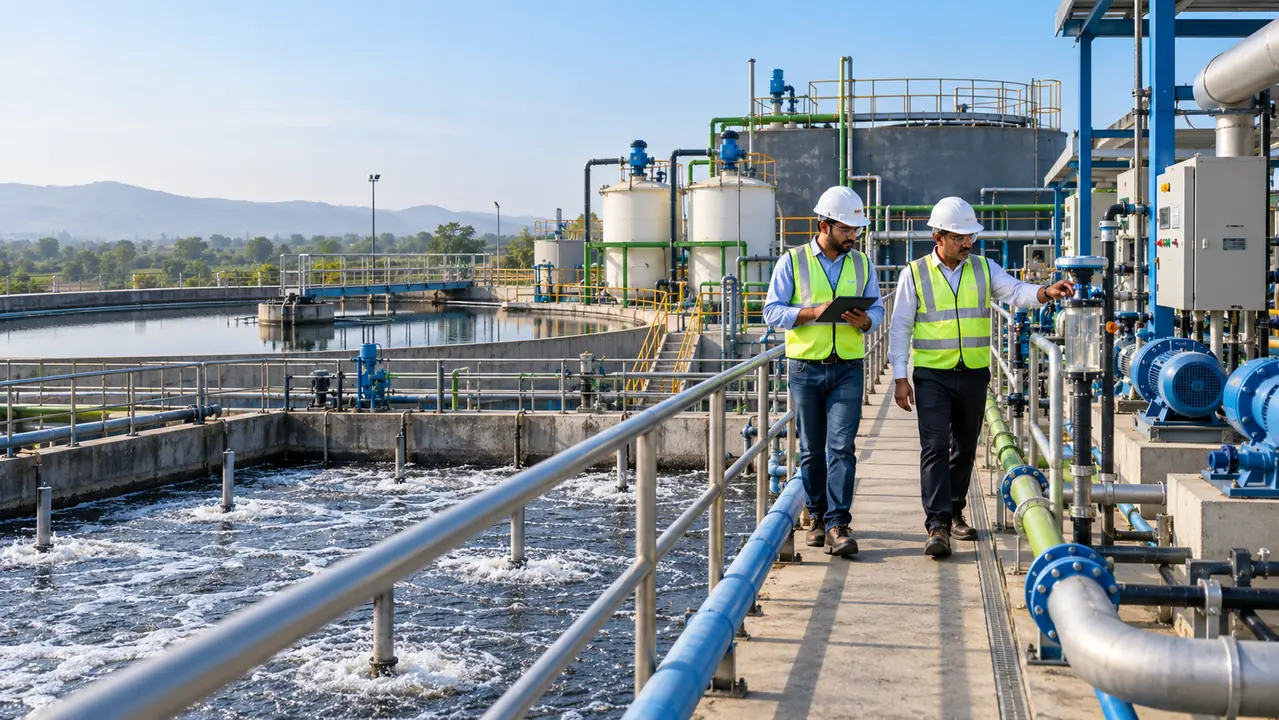
An ETP does not suddenly become “old” on a particular date. It becomes unsuitable when the current wastewater load, production conditions, treatment requirement or operating expectations no longer match what the plant was originally designed to handle.
That mismatch can appear as repeated high COD or BOD, poor sludge settling, rising chemical consumption, inadequate aeration, frequent breakdowns, unstable outlet quality, excessive operator intervention, insufficient capacity or inability to meet current reuse or compliance requirements.
What Should Be Checked Before Revamping an ETP?
Before revamping an industrial ETP, compare the original design basis with current wastewater conditions, then assess hydraulic load, COD/BOD load, equalization, chemical treatment, biological treatment, aeration, clarification, sludge handling, equipment condition, instrumentation, treated-water requirements and future production plans.
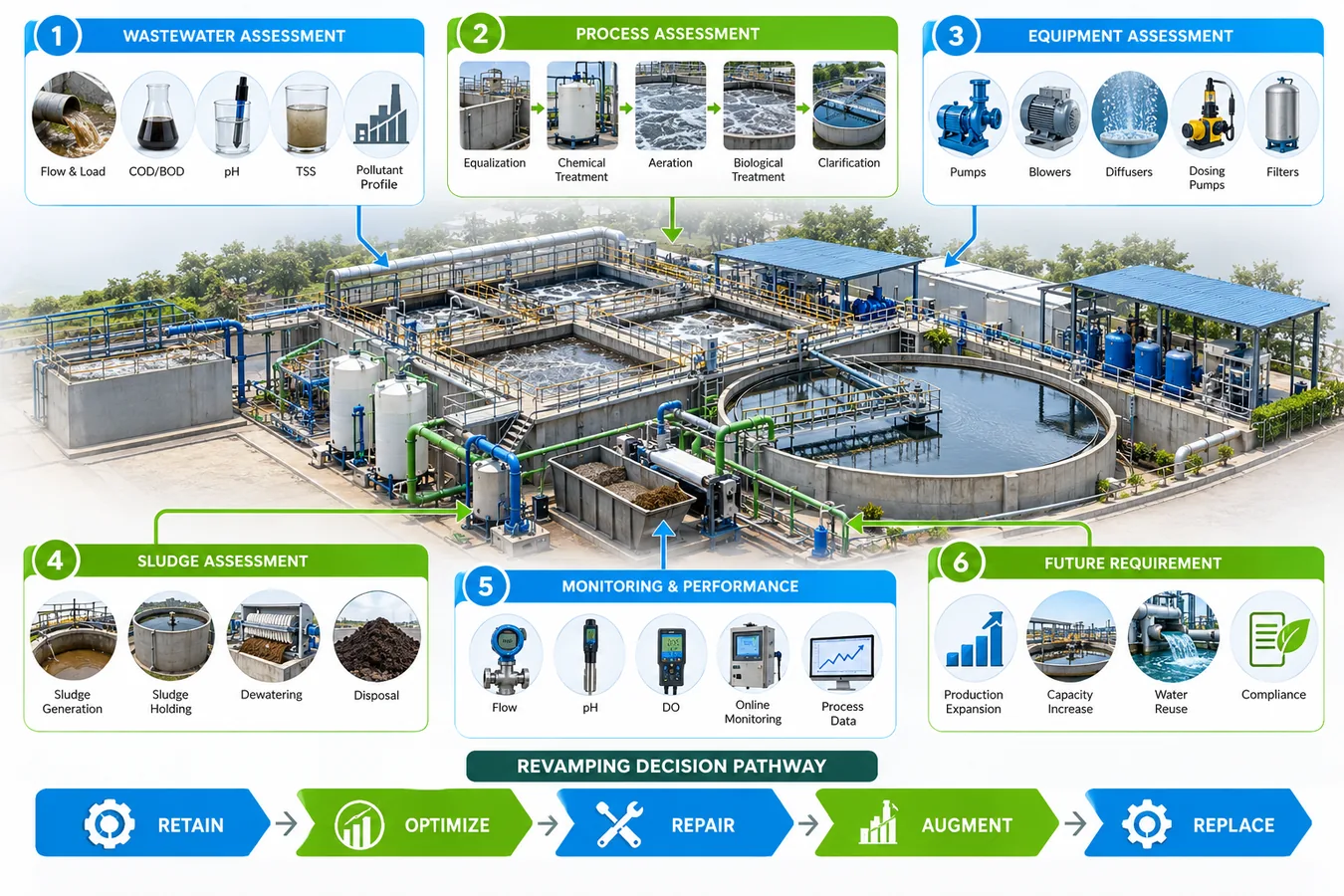
The objective is to determine: What can be retained → What can be optimized → What needs augmentation → What must be replaced.
An ETP does not suddenly become “old” on a particular date.
It becomes unsuitable when the current wastewater load, production conditions, treatment requirement or operating expectations no longer match what the plant was originally designed to handle.
That mismatch can show up as:
- repeated high COD or BOD,
- poor sludge settling,
- rising chemical consumption,
- inadequate aeration,
- frequent breakdowns,
- unstable outlet quality,
- excessive operator intervention,
- insufficient capacity,
- or inability to meet current reuse or compliance requirements.
At that point, the next question is usually:
Should we repair the ETP, optimize it, expand it, revamp it or replace it completely?
The answer should come from a structured plant assessment, not from guesswork.
This checklist is designed to help Plant Heads, Environment Heads, EHS teams, Utility Heads and management evaluate an existing industrial ETP before taking a revamping decision.
Before revamping an industrial ETP, compare the original design basis with current wastewater conditions, then assess hydraulic load, COD/BOD load, equalization, chemical treatment, biological treatment, aeration, clarification, sludge handling, equipment condition, instrumentation, treated-water requirements and future production plans.
The objective is to determine:
What can be retained → What can be optimized → What needs augmentation → What must be replaced.
You will learn:
- When an existing ETP actually needs revamping
- What to check before investing in new equipment
- How to compare present performance against original design
- Which treatment stages commonly become bottlenecks
- How to prepare an ETP revamping scope
- When optimization is enough and when major modification is required
What Is ETP Revamping?
ETP revamping means modifying an existing Effluent Treatment Plant so that it can reliably handle the plant's current and future wastewater treatment requirements.
Revamping may involve:
- process optimization,
- equipment replacement,
- capacity augmentation,
- additional treatment stages,
- improved aeration,
- improved equalization,
- sludge-system modification,
- automation,
- instrumentation,
- tertiary-treatment upgrades,
- water-recovery integration,
- or partial redesign.
It does not automatically mean replacing the entire ETP.
A well-planned revamp should preserve useful existing assets wherever technically and economically practical.
When Should an Industrial Plant Consider ETP Revamping?
Consider a detailed revamping assessment when one or more of these conditions become recurring.
Performance Problems
- COD regularly remains high
- BOD reduction is inconsistent
- TSS remains high
- Sludge does not settle properly
- Outlet quality fluctuates
- pH is difficult to control
- Biological treatment frequently becomes unstable
Capacity Problems
- Production has increased
- Wastewater flow has increased
- Pollutant load has increased
- Existing tanks are undersized
- Retention time is inadequate
- Clarifier capacity is insufficient
Operating-Cost Problems
- Chemical consumption is excessive
- Power consumption is rising
- Blowers run continuously at high load
- Sludge generation is excessive
- Maintenance cost keeps increasing
- Operator dependency is high
Equipment Problems
- Pumps fail frequently
- Diffusers choke repeatedly
- Blowers have lost efficiency
- Instruments are unreliable
- Dosing systems are inaccurate
- Existing equipment is obsolete
Compliance or Reuse Problems
- Outlet quality is approaching or exceeding applicable requirements
- Consent conditions have changed
- Production expansion changes pollution load
- The company wants higher water reuse
- New downstream recovery treatment is planned
MPCB's consent framework requires industries discharging trade effluent to maintain the relevant pollution-control systems and obtain the appropriate Consent to Establish and Consent to Operate. For Consent to Operate/renewal, MPCB information includes details of pollution-control systems and effluent analysis among the information relevant to the application process.
The First Rule: Do Not Start With Equipment
A common revamping mistake is to begin with:
“We need another blower.”
or:
“We need one more tank.”
or:
“Let's install a larger clarifier.”
That is the wrong starting point.
The correct starting point is:
What exactly is preventing the existing ETP from achieving the required performance?
A plant may have enough tank volume but inadequate oxygen transfer.
Another may have sufficient aeration but poor equalization.
Another may have adequate biological treatment but excessive solids carryover.
Another may simply be handling wastewater that is very different from its original design basis.
Equipment selection should come after the bottleneck is identified.
ETP Revamping Checklist
Use the following checklist before preparing the final scope.
1. Collect the Original ETP Design Data
Before inspecting the current plant, understand what it was originally intended to treat.
Collect:
- Design wastewater flow
- Peak flow
- Design COD
- Design BOD
- TSS
- pH range
- Oil & grease
- TDS
- Industry-specific pollutants
- Original production capacity
- Treatment philosophy
- Original process flow diagram
- Tank capacities
- Equipment specifications
- Hydraulic retention times
- Sludge-management design
Key question
What wastewater was this ETP designed for?
Without this information, it becomes difficult to determine whether the plant is failing or simply being asked to treat something outside its original design envelope.
2. Measure Current Wastewater Characteristics
Now compare design assumptions with present reality.
Measure actual:
- Daily wastewater flow
- Peak-hour flow
- COD
- BOD
- TSS
- pH
- Oil & grease
- TDS where relevant
- Temperature
- Toxic or industry-specific pollutants
- Production-related contaminants
Sampling should account for production variation rather than relying only on one convenient sample.
Compare:
vs.
This often reveals the revamping requirement immediately.
3. Calculate Actual Pollution Load
Do not evaluate an ETP only in KLD.
A plant designed for 100 KLD is not automatically safe because the current flow is only 80 KLD.
Pollutant concentration matters.
For COD:
Example:
Original Design
Flow = 100 m³/day
COD = 2,000 mg/L
COD load:
200 kg/day
Current Condition
Flow = 80 m³/day
COD = 3,500 mg/L
COD load:
280 kg/day
Wastewater quantity is lower.
But COD load is 40% higher.
This is exactly why revamping studies should evaluate both:
4. Review Wastewater Source Segregation
Before modifying the ETP, understand where different wastewater streams originate.
Map:
- process wastewater,
- wash water,
- CIP streams,
- cooling-related discharge,
- oily wastewater,
- acidic streams,
- alkaline streams,
- high-COD batches,
- low-COD wastewater,
- toxic streams.
Important question
Can any stream be:
- segregated,
- treated separately,
- recovered,
- reused,
- equalized differently,
- prevented from reaching biological treatment?
Sometimes source-level changes reduce the required ETP modification dramatically.
5. Assess Equalization Capacity
Equalization protects downstream treatment from fluctuations.
Check:
- Tank volume
- Actual retention time
- Peak flow handling
- Mixing arrangement
- Dead zones
- pH fluctuation
- COD fluctuation
- Batch-discharge pattern
- Pumping strategy
CPCB has identified fluctuations in effluent quality and quantity, overload/shock loads, poor segregation and inadequate treatment-process control among important factors affecting treatment-plant performance in its discussion of CETP operation and maintenance.
Revamping opportunity
The requirement may involve:
- increasing equalization volume,
- improving mixing,
- automated transfer,
- controlled pumping,
- source segregation,
- pH control.
6. Review pH Correction and Chemical Treatment
Check whether the current physico-chemical stage is still appropriate for today's wastewater.
Inspect:
- pH correction
- Chemical selection
- Coagulant dose
- Polymer dose
- Mixing intensity
- Floc formation
- Reaction time
- Settling
- Dosing-pump calibration
- Chemical-storage and preparation systems
Ask:
Are operators increasing chemicals because wastewater has changed?
If yes, adding more chemical is not necessarily the correct long-term solution.
Conduct controlled testing such as jar trials where appropriate.
7. Check Primary Treatment Performance
Measure the actual removal achieved before biological treatment.
Compare:
Raw wastewater
After primary treatment
Review reduction in:
- COD
- TSS
- oil & grease
- other applicable contaminants
If primary treatment is underperforming, the biological system may be receiving significantly more load than intended.
8. Audit the Aeration System
Aeration is often one of the most critical areas in ETP revamping.
Check:
- Blower capacity
- Actual air delivery
- Blower efficiency
- Diffuser condition
- Air distribution
- Oxygen-transfer effectiveness
- Tank geometry
- Mixing
- DO profile
- Current biological loading
Do not assume that:
Blower ON = sufficient aeration
Measure dissolved oxygen at multiple points.
Possible revamping options
Depending on diagnosis:
- diffuser replacement,
- improved diffuser layout,
- blower resizing,
- additional blower capacity,
- improved air distribution,
- VFD-based control,
- improved DO monitoring.
9. Assess Biological Treatment Health
Evaluate the biological process as a system.
Review:
- MLSS
- MLVSS where applicable
- DO
- pH
- sludge settling
- sludge age
- return sludge
- sludge wasting
- food-to-microorganism relationship
- nutrient balance
- toxic shock history
- biological stability
Look for symptoms
- persistent foam,
- poor settling,
- floating sludge,
- low oxygen,
- biomass loss,
- recurring biological collapse.
If the biological system cannot handle the current organic loading, revamping may require more than equipment maintenance.
Identify the Bottleneck Before You Buy New Equipment
A structured revamping assessment can separate operational issues from genuine process, capacity and equipment limitations.
Explore ETP Performance & Revamping →10. Check Hydraulic Retention Time
Every treatment stage needs adequate contact time.
Calculate actual HRT for:
- Equalization
- Reaction tank
- Aeration
- Clarification
- Other process stages
Production expansion can reduce retention time even when all tanks remain physically intact.
Revamping options may include
- additional tank volume,
- flow balancing,
- process intensification,
- altered treatment configuration,
- load reduction upstream.
11. Evaluate Clarifier Performance
A biological process can work reasonably well and still produce poor outlet water if the clarifier fails.
Inspect:
- Surface loading
- Sludge blanket
- Settling
- Hydraulic distribution
- Weirs
- Sludge withdrawal
- Return sludge
- Short-circuiting
- Solids carryover
Warning sign
If COD and TSS rise together, poor clarification or solids carryover may be contributing significantly to outlet COD.
12. Review Sludge Handling
Sludge is frequently treated as an afterthought during ETP design.
During a revamp, check:
- Sludge generation
- Sludge holding
- Thickening
- Dewatering
- Filter press condition
- Pumps
- Drying/storage
- Disposal practice
- Hazardous-waste implications where applicable
Also determine whether higher chemical dosing has increased sludge unnecessarily.
13. Audit Every Major Equipment Item
Create an equipment-condition register.
| Equipment | Check |
|---|---|
| Pumps | Flow, head, efficiency, wear |
| Blowers | Airflow, pressure, efficiency |
| Diffusers | Choking, distribution, condition |
| Agitators | Mixing effectiveness |
| Dosing pumps | Calibration and capacity |
| Clarifier mechanism | Mechanical condition |
| Sludge pumps | Capacity and reliability |
| Filters | Pressure loss and media condition |
| Instruments | Calibration and accuracy |
Classify each item as:
Retain | Repair | Upgrade | Replace
This avoids replacing equipment simply because it is old.
14. Review Instrumentation and Monitoring
Modernizing instrumentation can sometimes improve ETP performance without major civil expansion.
Depending on process needs, evaluate:
- pH
- Flow
- DO
- Level
- ORP where relevant
- Pressure
- Conductivity/TDS where relevant
- Online effluent monitoring where applicable
Ask:
- Are instruments calibrated?
- Are readings reliable?
- Are operators acting on the data?
- Is there historical data?
- Are alarms configured?
Monitoring is valuable only when it supports operating decisions.
15. Check Whether Manual Operation Is Causing Variability
Some ETPs depend heavily on individual operator judgement.
Examples:
- Manual chemical dosing
- Manual pump switching
- Manual sludge wasting
- Manual aeration control
- Manual tank transfer
This can create different plant performance between:
- shifts,
- operators,
- production days.
Revamping may include practical automation where it meaningfully reduces variability.
16. Evaluate Treated-Water Requirements
Ask:
Where will the treated water go?
Possibilities include:
- approved discharge,
- CETP,
- gardening,
- utilities,
- cooling,
- washing,
- process reuse,
- downstream RO,
- recovery system.
The required treatment level depends heavily on the final objective.
For Maharashtra consent processes, MPCB documentation has historically captured ETP capacity, treatment units, retention time, treated/untreated effluent characteristics, disposal mode and quantity reused or recycled, showing why these parameters matter in pollution-control planning.
17. Review Compliance Requirements
Do not design a revamp around a generic internet discharge number.
Applicable requirements may depend on:
- industry category,
- disposal route,
- environmental standards,
- MPCB consent conditions,
- reuse requirements,
- specific pollutants.
CPCB publishes industry-specific effluent standards, and the applicable limits can vary by sector.
Always review the facility's current consent and applicable standards before finalizing the revamped process.
18. Evaluate Future Production, Not Just Today's Load
A revamp designed only for today's problem can become undersized again very quickly.
Understand planned:
- production expansion,
- additional lines,
- new products,
- new raw materials,
- water-conservation projects,
- reuse targets,
- regulatory requirements.
Ask management for at least a realistic future production scenario.
The revamp should have a defined design horizon.
19. Identify What Can Be Reused
A proper revamping study should protect usable assets.
Potentially reusable items may include:
- civil tanks,
- pipelines,
- pumps,
- blowers,
- filters,
- clarifiers,
- electrical systems,
- instrumentation,
- sludge-handling equipment.
However, reuse should be based on:
not simply on the desire to reduce capital cost.
20. Develop a Stage-Wise Revamping Plan
Avoid shutting down the entire ETP unless unavoidable.
A practical project plan should consider:
Phase 1
Immediate operational corrections
Phase 2
Critical equipment replacement
Phase 3
Process modifications
Phase 4
Capacity augmentation
Phase 5
Automation / monitoring
Phase 6
Water recovery or advanced treatment where required
This can help reduce operational disruption.
Complete ETP Revamping Checklist
Use this during a plant assessment.
Wastewater
☐ Current flow measured
☐ Peak flow measured
☐ COD measured
☐ BOD measured
☐ TSS measured
☐ pH range established
☐ Oil & grease checked
☐ Specific pollutants identified
☐ Source streams mapped
☐ Batch discharges identified
Design Review
☐ Original PFD available
☐ Original design flow known
☐ Original COD/BOD known
☐ Original production basis known
☐ Tank capacities verified
☐ Equipment specifications verified
Process
☐ Equalization checked
☐ Chemical treatment assessed
☐ Aeration assessed
☐ Biological process reviewed
☐ Clarifier assessed
☐ Sludge handling checked
☐ Tertiary treatment checked
Equipment
☐ Pumps audited
☐ Blowers audited
☐ Diffusers inspected
☐ Dosing pumps calibrated
☐ Agitators checked
☐ Filters checked
☐ Clarifier mechanism checked
☐ Sludge equipment checked
Instrumentation
☐ Flow meter
☐ pH meter
☐ DO meter
☐ Level instruments
☐ Other process instruments
☐ Calibration records
☐ Data logging
Compliance
☐ Current MPCB consent reviewed
☐ Applicable outlet requirements confirmed
☐ Latest laboratory reports reviewed
☐ Sludge disposal reviewed
☐ Monitoring requirements reviewed
Future Requirement
☐ Production growth considered
☐ Future wastewater flow considered
☐ Future pollutant load considered
☐ Reuse target defined
☐ Required redundancy defined
ETP Revamping Decision Matrix
| Finding | Likely Action |
|---|---|
| Process healthy but equipment inefficient | Repair / replace equipment |
| Poor operation and dosing | Optimize operation |
| Inadequate monitoring | Instrumentation / automation upgrade |
| Aeration insufficient | Aeration-system upgrade |
| Equalization inadequate | Equalization augmentation |
| Existing biology overloaded | Biological process augmentation |
| Clarifier overloaded | Clarification upgrade |
| Flow significantly increased | Capacity augmentation |
| Wastewater chemistry fundamentally changed | Process redesign |
| Most major assets unsuitable | Major revamp / replacement evaluation |
Optimization vs Revamping vs New ETP
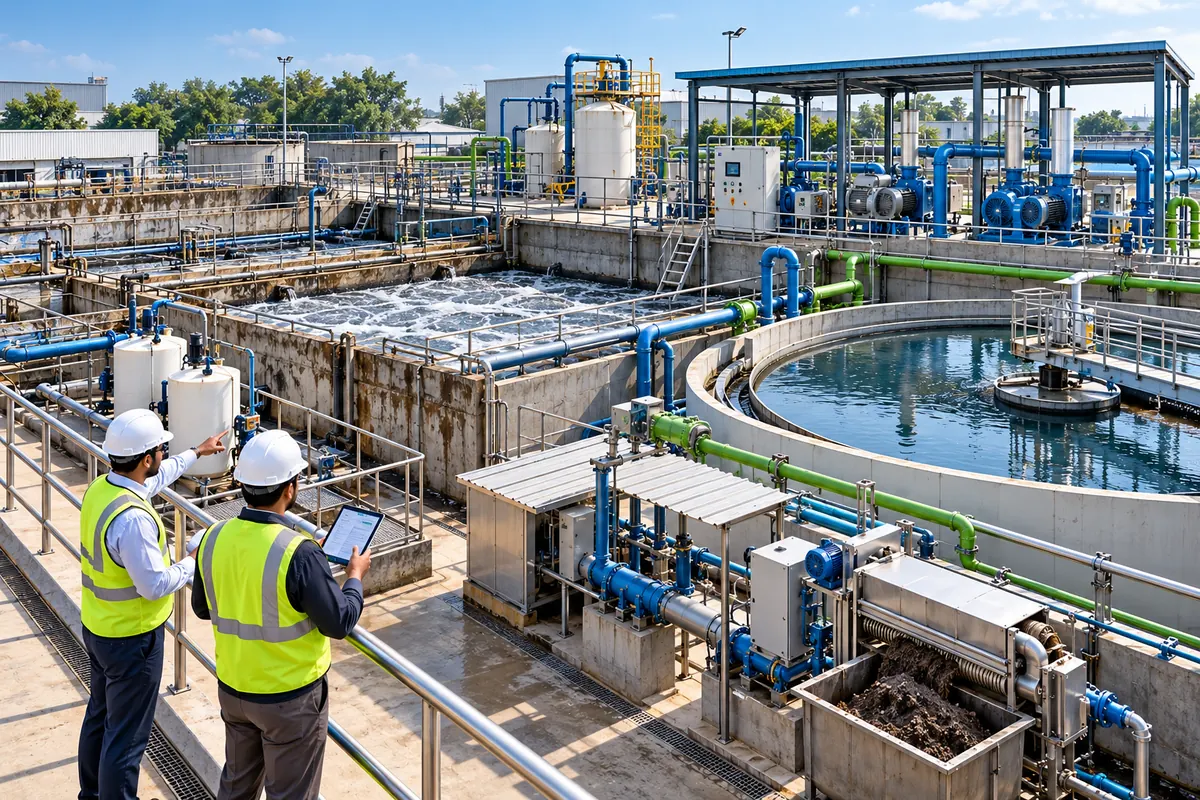
Optimize Existing ETP
Best when:
- capacity is broadly adequate,
- process is suitable,
- operating control is poor,
- equipment condition is reasonable.
Revamp Existing ETP
Best when:
- useful assets remain,
- wastewater has changed,
- selective capacity needs expansion,
- some processes or equipment need modernization.
Install New ETP
May be appropriate when:
- most major assets are structurally or technically unsuitable,
- required capacity is far beyond existing infrastructure,
- wastewater characteristics require a fundamentally different process,
- modification becomes uneconomical or operationally impractical.
The decision should come from engineering and lifecycle economics, not equipment age alone.
Hydropure Insight: Revamp the Bottleneck, Not the Whole Plant
The most useful output from an ETP audit is not a long equipment shopping list.
It is a clear answer to:
What is preventing the existing plant from performing reliably?
Once that bottleneck is identified, the project can focus investment where it creates measurable treatment improvement.
That may mean:
better equalization rather than a larger ETP.
better aeration rather than another tank.
better clarification rather than more chemicals.
Or it may confirm that significant capacity augmentation is genuinely required.
Planning an ETP Revamp in Maharashtra?
Hydropure Consultants can assess an existing industrial ETP from a performance, capacity and compliance perspective.
The review can cover:
- Current wastewater characteristics
- Original vs current design load
- COD/BOD loading
- Stage-wise treatment efficiency
- Equalization
- Chemical treatment
- Biological treatment
- Aeration
- Clarification
- Sludge handling
- Equipment condition
- Instrumentation
- Current bottlenecks
- Future production requirement
- Potential reuse/recovery requirement
For industrial plants in Chhatrapati Sambhajinagar / Aurangabad, Jalna, Nashik, Ahilyanagar / Ahmednagar and other relevant Maharashtra locations, the objective should be to determine the right combination of:
Request an ETP Revamping Assessment
Planning an ETP Revamp in Maharashtra?
Hydropure Consultants can assess your existing ETP from a performance, capacity and compliance perspective, then identify the right combination of Retain | Optimize | Repair | Augment | Replace.
Request an ETP Revamping AssessmentFAQs
How do I know whether my ETP needs revamping?
Recurring compliance or performance problems, increasing wastewater load, higher COD/BOD, insufficient retention time, frequent breakdowns, rising operating cost and production changes are strong reasons to conduct a revamping assessment. They do not automatically mean that the complete ETP must be replaced.
Can an old ETP be upgraded instead of replaced?
Yes. Civil tanks and other infrastructure may remain usable if their condition, volume and process suitability are adequate. Equipment and selected treatment stages can then be repaired, augmented or replaced.
What should be checked first before ETP revamping?
Start by comparing the original ETP design basis with current flow, COD, BOD, TSS, pH, pollutant characteristics and production load. This establishes whether the existing plant is operating inside or outside its original design envelope.
Does increasing production always require a larger ETP?
No. The requirement depends on actual wastewater volume and pollutant load. Production may increase without proportional wastewater increase, or water conservation may reduce flow while increasing pollutant concentration.
Can aeration improvement solve an overloaded ETP?
It can solve some oxygen-transfer or biological-capacity problems, but not every form of overloading. Equalization, retention time, wastewater biodegradability, clarification and other bottlenecks also need evaluation.
Should automation be included during ETP revamping?
Automation can improve consistency when important operations depend excessively on manual control. It should be applied where it meaningfully improves dosing, aeration, transfer, monitoring, alarms or operating reliability.
How should compliance be considered during ETP revamping?
Review the facility's current MPCB consent conditions and applicable CPCB/industry-specific requirements before defining the outlet design basis. Do not use one generic discharge standard for every industry.
How do we decide between revamping and installing a new ETP?
Compare asset condition, process suitability, required capacity, future load, implementation disruption and lifecycle cost. If major existing infrastructure can be technically reused, revamping may be more practical. If most of the plant is unsuitable, a new system may be justified.