
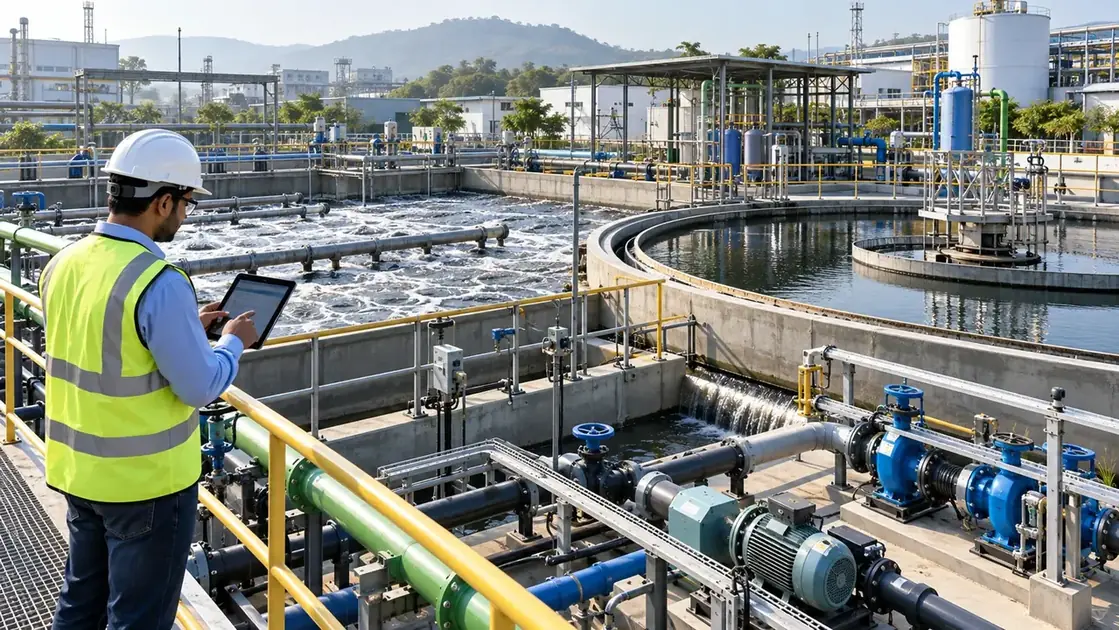
Your pumps are running. The blower is running. Chemicals are being dosed. The operator says the ETP is operating normally. Yet COD remains high, sludge refuses to settle, the aeration tank keeps foaming, outlet water looks cloudy, chemical consumption is increasing or the treated effluent is repeatedly moving towards unacceptable levels.
This is a common industrial wastewater-treatment problem. An ETP can be operational without being effective.
Why Is an ETP Not Working Properly?
An ETP normally begins to underperform when the wastewater entering the plant no longer matches its design conditions, treatment stages are not being operated correctly, biological activity becomes unstable, chemical dosing is incorrect, hydraulic or organic loading increases, sludge management deteriorates, or critical equipment loses performance.
The solution is to identify the failing treatment stage before adding chemicals, equipment or capacity.
Common Warning Signs of Poor ETP Performance
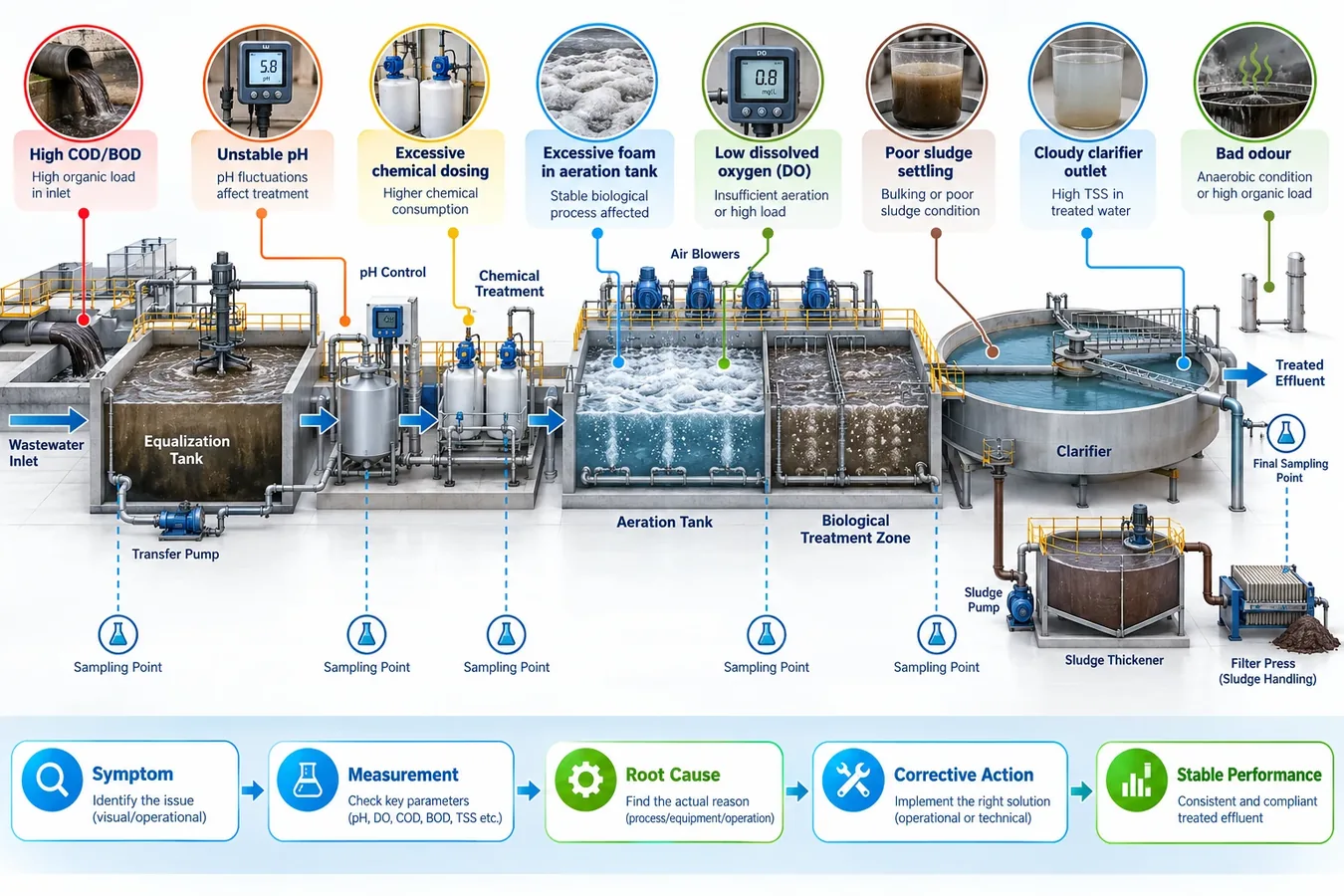
10 Common Reasons an Industrial ETP Stops Performing Properly
High COD or BOD in the Treated Water
High outlet COD or BOD does not automatically mean that the biological tank is the problem. The issue can begin much earlier.
Possible causes
- Incoming organic load has increased
- Wastewater composition has changed
- Equalization is inadequate
- Biological activity has reduced
- Aeration is insufficient
- Toxic chemicals are entering the biological stage
- Hydraulic retention time has reduced
- Production has increased beyond original design assumptions
Check: Inlet COD/BOD → stage-wise reduction → outlet COD/BOD. This helps determine where treatment efficiency is being lost.
Sudden pH Fluctuations
Cleaning cycles, CIP operations, batch dumping, acid washing, alkali cleaning and production changes can create sudden shifts. Review source segregation → equalization → mixing → pH measurement → dosing control → downstream biological protection.
Aeration Tank Has Low Dissolved Oxygen
A blower running does not automatically mean that sufficient oxygen is reaching the wastewater. Check DO at multiple tank locations, air pressure, blower performance, diffuser condition, bubble distribution, MLSS, organic load and tank mixing.
Sludge Is Not Settling Properly
Poor settling can lead to high TSS, cloudy treated water, sludge carryover, loss of active biomass and increasing biological instability. Check DO + MLSS + settling characteristics + return sludge + wasting rate + inlet loading.
Excessive Foam in the Aeration Tank
White foam may indicate young biomass, low MLSS, surfactants or detergents. Dark or persistent biological foam may indicate old sludge, biological imbalance or poor sludge wasting. Antifoam should not become a permanent substitute for diagnosis.
ETP Produces a Strong Bad Odour
Possible causes include septic conditions, insufficient aeration, stagnant wastewater, sludge remaining too long, anaerobic pockets, poor equalization and high organic load. Start by identifying the exact source of the odour.
Chemical Consumption Keeps Increasing
Increasing chemical use may indicate declining process control. Review wastewater characteristics, chemical selection, pH stability, jar tests and dosing-pump calibration rather than simply increasing yesterday's dose.
The Clarifier Outlet Is Cloudy or Carrying Solids
Before increasing polymer dosage, determine whether you have a chemical treatment problem, biological problem, hydraulic problem or equipment problem.
Production Has Changed But the ETP Has Not
Factories evolve. Production expands, product mix changes and water conservation can reduce flow while increasing pollutant concentration. Compare Original Design Basis vs Current Actual Wastewater Characteristics.
Equipment Is Running, But No Longer Performing Efficiently
Worn pump impellers, choked diffusers, reduced blower efficiency, faulty probes, dosing-pump calibration errors, blocked pipelines and instrument drift can remain hidden because the equipment still switches on.
ETP Troubleshooting: Symptom → Cause → First Check
| Symptom | Likely causes | Check first |
|---|---|---|
| High outlet COD | Overloading, poor biological treatment, toxic load | Inlet vs outlet COD and stage efficiency |
| High BOD | Low biological activity, insufficient aeration | DO, MLSS and organic load |
| pH fluctuation | Batch discharge, inadequate equalization | Source streams and equalization |
| Low DO | Blower/diffuser issue or high loading | DO profile and aeration system |
| Sludge not settling | Bulking or biological imbalance | MLSS, settling and DO |
| Aeration foam | Surfactants, young/old sludge, imbalance | Foam type and process changes |
| Bad odour | Septic conditions | Odour source and DO |
| Cloudy outlet | Poor settling or clarification | Sludge blanket and clarifier |
| High chemical use | Poor dosing optimization | Jar test and dosing calibration |
| Frequent breakdowns | Ageing equipment / poor maintenance | Equipment condition audit |
Do Not Treat the Symptom Before Finding the Root Cause
One of the most expensive ETP operating mistakes is trying to solve every problem with more chemicals, more aeration, more manpower, more sludge removal or new equipment before understanding the reason for the problem.
Find Where Treatment Efficiency Is Actually Being Lost
Repeatedly correcting ETP symptoms without identifying the underlying process problem can increase chemicals, energy and operator dependency. A plant-performance assessment can help identify the actual bottleneck.
Explore ETP Performance & Revamping →A Simple 7-Step ETP Performance Audit
Understand Current Wastewater
Measure actual flow, pH, COD, BOD, TSS, oil & grease, TDS where relevant and industry-specific pollutants.
Compare With Original Design
Compare both hydraulic load and pollutant load. Flow alone is not enough.
Calculate Stage-Wise Performance
Determine what each treatment stage removes to identify the bottleneck.
Review Chemical Treatment
Check selection, dose, preparation, pH, mixing and dosing calibration.
Evaluate Biological Health
Review DO, MLSS/MLVSS where applicable, settling, sludge return, wasting, organic loading and nutrient balance.
Audit Mechanical Equipment
Inspect pumps, blowers, diffusers, agitators, clarifiers, filters and instruments.
Compare Outlet Quality With Requirements
Check the applicable consent, industry-specific requirements and disposal route rather than relying on one generic number.
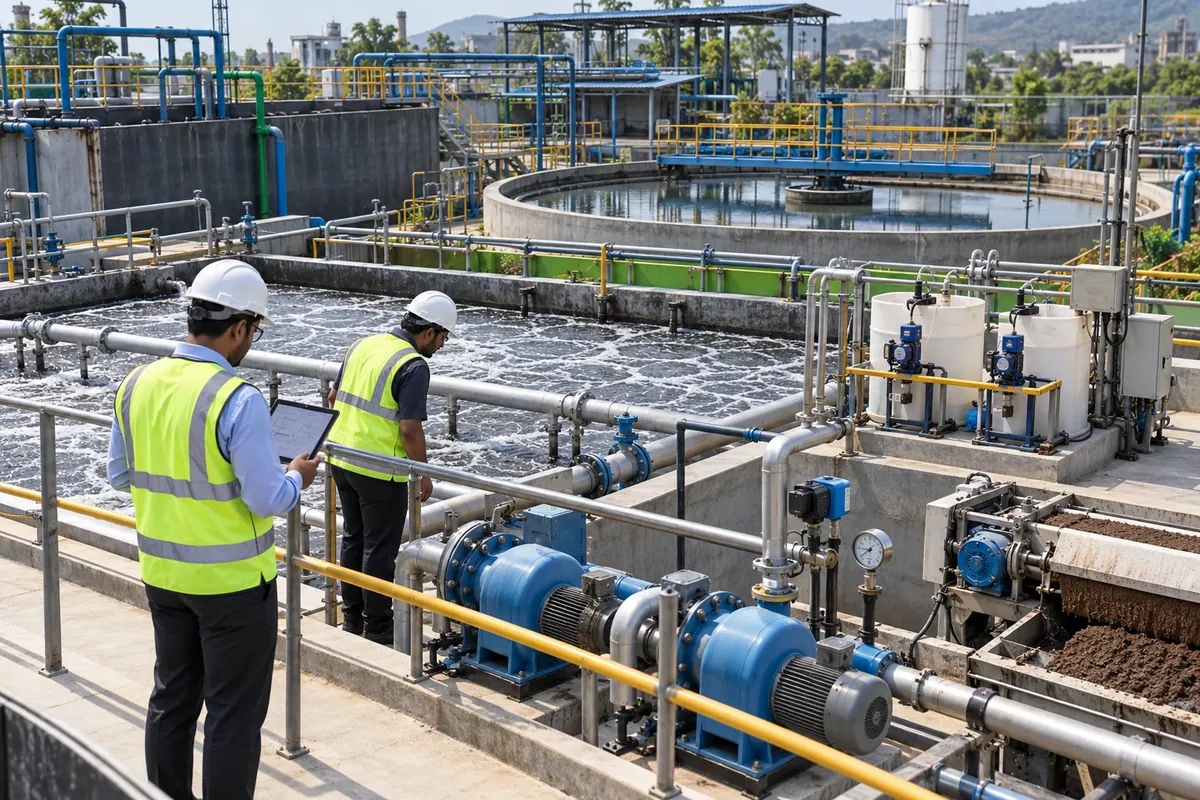
When Does an ETP Need Revamping Instead of Routine Maintenance?
Not every ETP performance problem requires a new plant. Many existing ETPs can be improved. Revamping should be investigated when performance problems are chronic, wastewater characteristics have changed, capacity is constrained, equipment repeatedly fails or stable output cannot be achieved despite repeated maintenance.
The important question is not “How old is the ETP?” It is: Can the existing process reliably handle today's wastewater load and tomorrow's production requirement?
When Should You Bring in an ETP Specialist?
Consider a detailed ETP performance review if outlet parameters repeatedly fluctuate, COD/BOD reduction is inadequate, chemical consumption keeps increasing, biological treatment frequently crashes, sludge settling remains unstable, production has expanded, wastewater composition has changed, equipment is ageing or management is considering a new ETP.
A plant-level assessment can help determine whether the requirement is optimization, repair, augmentation, technology modification or full revamping.
ETP Performance Support in Aurangabad and Maharashtra
Hydropure Consultants works across Design | Treat | Recover | Monitor | Optimize | Comply. For industries in Chhatrapati Sambhajinagar / Aurangabad, Jalna, Nashik, Ahilyanagar / Ahmednagar and other relevant Maharashtra locations, an ETP performance review can help identify why an existing treatment plant is not delivering the expected output and what practical modifications may improve it.
ETP Troubleshooting FAQs
Why is COD high in my ETP outlet?
High COD can result from increased inlet load, inadequate primary treatment, insufficient biological activity, toxic wastewater, low aeration, reduced retention time or wastewater characteristics that the existing treatment process cannot adequately handle. Compare stage-wise COD reduction before changing chemicals or equipment.
Why is BOD not reducing in an ETP?
Poor BOD reduction is often associated with unstable biological treatment. Check dissolved oxygen, active biomass, organic loading, pH, toxic chemical entry, sludge management and hydraulic retention conditions.
Why is ETP sludge not settling?
Poor settling may result from sludge bulking, low DO, incorrect sludge age, hydraulic overload, biological imbalance, nutrient problems or clarifier issues. The biological process and clarifier should be evaluated together.
Why is there foam in the ETP aeration tank?
Foam may result from detergents or surfactants, young biomass, old sludge, filamentous organisms or sudden wastewater changes. The colour and persistence of the foam can provide useful diagnostic clues.
Can an old ETP be upgraded?
Yes. Depending on its structural condition, capacity and treatment process, an existing ETP may be improved through process optimization, additional treatment stages, aeration improvements, equipment replacement, instrumentation, automation or capacity augmentation.
Should we install a new ETP if the existing plant is failing?
Not necessarily. A performance audit should first determine whether the problem is related to operation, loading, equipment, process design or insufficient capacity. In many cases, targeted revamping may be more appropriate than complete replacement.
How often should ETP performance be reviewed?
Routine operating parameters should be monitored continuously or at frequencies appropriate to the process, while comprehensive performance reviews should be considered whenever wastewater characteristics, production load, compliance requirements or plant performance change significantly.
What should we check first when an ETP suddenly stops performing?
Start by identifying what changed. Review production, incoming wastewater flow and characteristics, pH, COD/BOD where available, DO, sludge condition, dosing, recent chemical discharge and equipment status before changing the treatment process.
Move From Repeated Fixes to a Structured Diagnosis
If you are repeatedly dealing with high COD/BOD, sludge problems, aeration issues, rising chemical consumption or unstable outlet quality, Hydropure Consultants can assess the existing plant, wastewater conditions, process performance and equipment to identify practical improvement or revamping opportunities.
Request an ETP Performance Review →